
Politics of female body in art: India’s Dancing Girl to canvas
In June 2026, a digitally covered torso of the Mohenjo-daro Dancing Girl appeared in the National Council of Educational Research and Training (NCERT) Class 9 arts textbook Madhurima, a move critics called an “act of censorship”. After the outcry, NCERT’s director announced that the original image would be restored. The episode was not isolated. In 2023, the Ministry of Culture’s mascot had already dressed the same bronze in a blouse and skirt. The irony runs deeper still. Other government academic study material on gender and art prints black dots over the private parts of Michelangelo’s David, Adam and Giorgione’s Dresden Venus, while describing this 4,500-year-old bronze as “a woman fully confident about herself and her world”. A civilisation that cast an unashamed woman in bronze now blurs the female body in its classrooms. The canvas is where that direction can be read, and the female body in art has become the test of how far society will let women be seen.
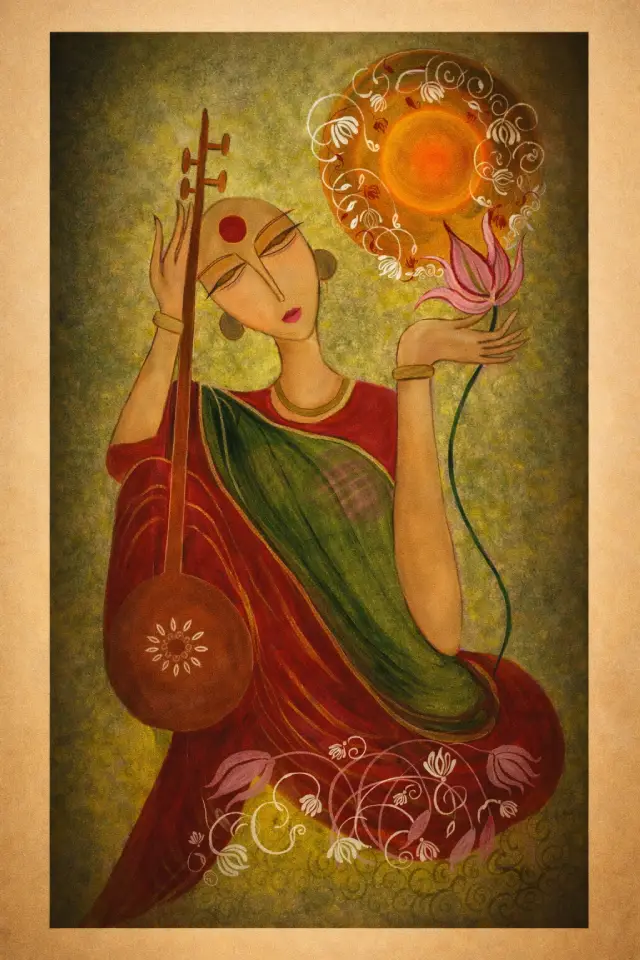
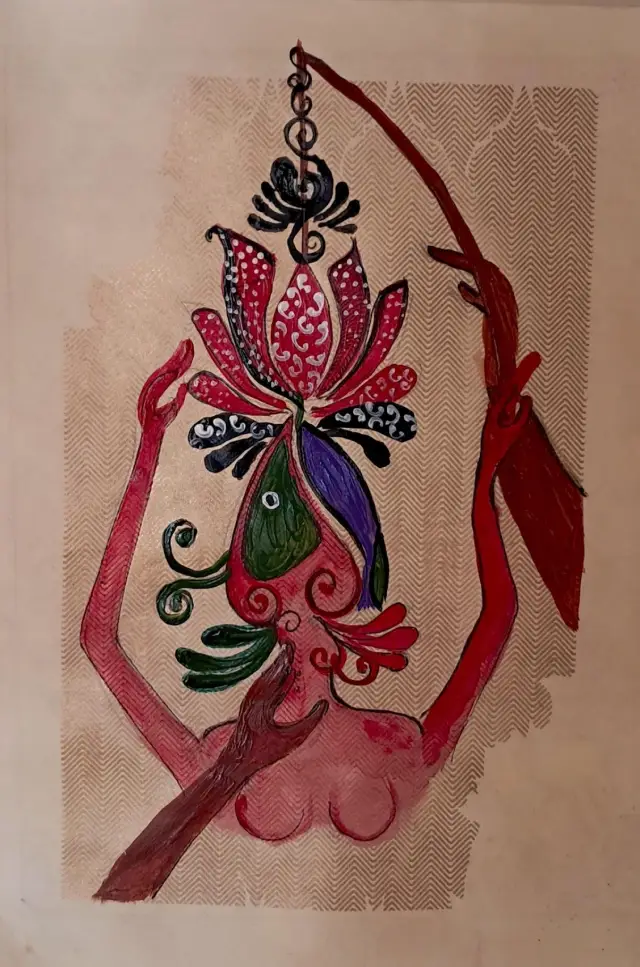
Paintings by Kashish Raj Sharma. Every woman painted carries more than a body; she embodies a culture, a community, a history of being seen and the possibility of being seen differently.
Goddess on the pedestal: the female body in art across India
Indian art was never prudish. Bhimbhetka’s rock paintings show the female body dancing and adorned. Khajuraho’s temples represent “eroticism as a socio-cultural aspect of the society of that time”. Konark’s Nata Mandir carries sculptures of the female body in sensuous poses, and Madhubani, painted by women alone, treats sexuality and gender as “common themes”. Tanjore and Mysore give goddesses as much space as gods, and Shakti and Durga embody strength.
Yet the symbol is not the citizen. By the colonial era, Bharat Mata, a four-armed goddess in saffron, stood at the centre of the nation’s iconography. As the scholars Sumathi Ramaswamy and Sadan Jha show, the feminisation of the nation made defending “her” honour a patriarchal duty. Jha’s analysis of a 1970s Bharat Mata, surrounded by miniature male devotees, shows the pattern: the nation is female, yet “her citizenry is conspicuously male”. Society worships the abstraction of the female body and withholds power from the actual woman.
Beauty without agency: the female body in art of the Renaissance
Europe repeated the contradiction. The Renaissance celebrated Michelangelo’s David, whose nudity “disrupts the post-lapsarian correlation between nudity and shame”. The male body became a vehicle for ideology, never “apolitical”. The female body was handled differently. Botticelli’s Primavera turns Venus into a “Marian figure: Christian, chaste, asexual and ‘pure'”. Titian’s Venus of Urbino lets the female body meet the viewer’s gaze, the sacred sexualised. At the opposite pole sits the artist’s “desperate attempt to sublimate female sensuality”. Leonardo’s Mona Lisa hints at a subject with a story, “bursting with a narrative” that convention will not let her tell.
The French Revolution distilled the paradox. Louis XVI’s impotence became political impotence, while Marie Antoinette’s power produced what Pierre Saint-Amand calls the “Marie Antoinette syndrome”: the fear of powerful women, to be restrained through humiliation or decapitation. Hélène Cixous names the mechanism: decapitation, the fear of losing a body part, deployed to silence women who question or “laugh at” the law of the father. Charlotte Corday and Olympe de Gouges, author of the Declaration of the Rights of Woman, met the guillotine too.
Jacques-Louis David’s The Oath of the Tennis Court birthed a body politic “exclusively and unambiguously male”, yet Eugène Delacroix’s Liberty became the Revolution’s emblem. The historian Monica Juneja explains why: the male form is a contextualised particular, while woman embodies the abstract. Hence the feminisation of Liberty turned the female body into “a sexualised lure for men to conquer”. The female body served as symbol, mother and pacifier, but the woman was not a citizen. Women artists faced the same prejudice, since their art was dismissed as “a slave to their biology”, and “feminine” retains a pejorative air until society revamps its gender politics.
Women seize the brush: the female body in art today
The 20th century answered back. Frida Kahlo painted women who are “not eager to please their (male) audiences”. In 1989 the Guerrilla Girls asked Do Women Have to Be Naked to Get into the Met. Museum?, exposing a museum of female nudes and male artists. Amrita Sher-Gil, Rekha Rodwittiya, Nalini Malani, Arpita Singh, Bharti Kher, Sheba Chhachhi and Pushpamala N. now turn the represented female body into the representing subject. An intersectional lens adds that caste, class and disability shape how the female body is read, so no single image stands for all women.
The stakes of how the female body is pictured are not abstract. The National Crime Records Bureau’s Crime in India 2024 recorded 441,534 cases of crimes against women, roughly one every 71 seconds, with cruelty by husband or relatives the largest category. The National Family Health Survey (NFHS-5) found that 29.3% of ever-married women aged 18 to 49 had experienced spousal violence. Registered cases and surveyed experiences measure different things, and both undercount. Art does not cause violence, but images of the female body train the imagination. A society that hands children a clothed bronze and a Bharat Mata, and teaches them that femininity means sacrifice, purity and family honour, is rehearsing conditional autonomy.
Dissolving the frame: the female body in art beyond the gaze
Sharma’s paintings emerge from this lineage, but they refuse its terms. Through abstraction, mixed media and mixed materials, she tries to locate beauty beyond the beauty of the female body and to blur the boundaries of gender and the stereotypes of feminine traits. Her paintings treat the female body as a site of voice rather than display.
The Unstruck Sound (The Sitar Bearer) reimagines Anahata nada, the unstruck sound. A divine, hairless woman holds a sitar, unsettling conventional ideals of feminine beauty and reclaiming divinity beyond prescribed femininity.
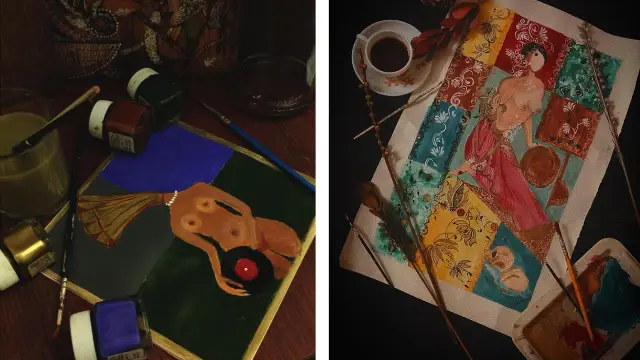
Beyond the Bound Canvas (The Faceless Torso) shows a woman whose breasts are visible but whose face is left unpainted, an empty space. The viewer cannot consume an identity, only confront the vacancy that a patriarchal gaze creates.
The Echo Chamber of Self plays with sound imagery (a gramophone) and the idea of personal history. The woman speaks and records, authoring her own story.
Two paintings by Kashish Raj Sharma: The Echo Chamber of Self, left, and Beyond the Bound Canvas, right
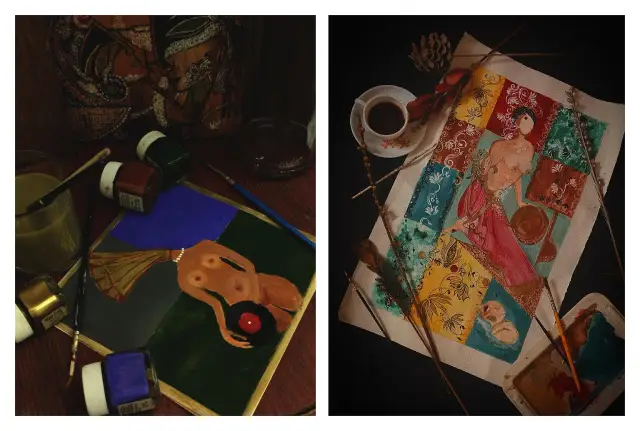
Left: The Echo Chamber of Self. Right: Beyond the Bound Canvas.
The Strangled Echoes shows a female body bearing the head of a fish whose neck is throttled, yet she still tries to speak. The body stands for society’s long attempt to subdue women, and the struggle to speak for the unfinished fight. Sharma uses the head as a recurring symbol of voice. Cixous’s decapitation haunts these works, but her women refuse to stay silent.
The woman beyond the frame
The Dancing Girl’s raised chin and hand on her hip have outlived empires, scholars’ nicknames and a censor’s software. The measure of India’s visual culture is whether the woman beyond the frame can stand as she does, confident about herself and her world, in a society that no longer needs to blur her body, throttle her neck or cover her torso. The country’s textbooks and classrooms are where that is decided, and the female body in art is where the answer will first show.
Sources
- John Berger, Ways of Seeing, Penguin Books, 1972.
- Hélène Cixous, “The Laugh of the Medusa”, Signs, 1(4), 1976, pp. 875–893.
- Laura Mulvey, “Visual Pleasure and Narrative Cinema”, Screen, 16(3), 1975, pp. 6–18.
- Linda Nochlin, “Why Have There Been No Great Women Artists?”, ARTnews, 69(9), 1971, pp. 22–39.
- Griselda Pollock, Vision and Difference: Femininity, Feminism and the Histories of Art, Routledge, 1988.
- Sumathi Ramaswamy, The Goddess and the Nation: Mapping Mother India, Duke University Press, 2010.
- International Institute for Population Sciences and Ministry of Health and Family Welfare, National Family Health Survey (NFHS-5), 2019–21: India, Government of India, 2021.
- National Crime Records Bureau, Crime in India, Ministry of Home Affairs, Government of India.
- The Indian Express, 2026, reports on the NCERT Class 9 textbook controversy over the Mohenjo-daro Dancing Girl figurine.

Kashish Raj Sharma is a 75% visually impaired postgraduate scholar of anthropology and an abstract artist whose work explores gender, embodiment, visual culture and social power.