
Putin’s India visit exposes New Delhi’s geopolitical tightrope
Russian President Vladimir Putin arrived in New Delhi on the evening of Thursday, December 4th, marking his first visit to India since Russia launched its military operation in Ukraine. The Russian president’s arrival has drawn attention not only from India but from the entire Western world, particularly the US.
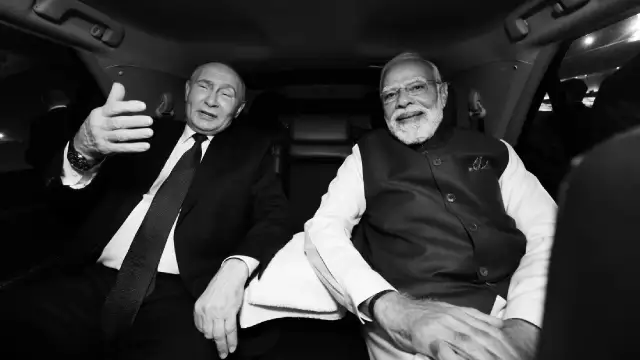
The annual India-Russia summit will proceed as scheduled, with Putin set to discuss bilateral relations with Prime Minister Narendra Modi in their customary format. Upon arrival, Modi welcomed the Russian president with considerable ceremony, escorting him directly from the airport to his residence for a private dinner. Indian media reported extensive discussions between the two leaders during this meeting.
Welcomed my friend, President Putin to 7, Lok Kalyan Marg.@KremlinRussia_E pic.twitter.com/2L7AZ1WIph
— Narendra Modi (@narendramodi) December 4, 2025
Ahead of Putin’s visit to India, Dmitry Peskov, the Kremlin’s press secretary, met with Indian journalists at the India Habitat Centre in New Delhi on December 2nd. He outlined Moscow’s position on India-Russia strategic bilateral relations and offered assurances about expanding military, technological and nuclear cooperation, though without providing concrete details.
Despite Foreign Minister S Jaishankar attending the Shanghai Cooperation Organization‘s (SCO) Council of Heads of Government meeting in Moscow in early November and holding bilateral talks with Russian Foreign Minister Sergei Lavrov, the Modi government remains anxious about the timing of Putin’s visit to India.
Oil diplomacy creates complications
Putin announced his official visit to India in May this year. While India initially welcomed the news, the Modi government now faces considerable pressure. The cause is oil diplomacy.
President Donald Trump has imposed an additional 25% tariff on Indian exports to the US because India continues purchasing discounted fuel from Russia. Combined with the existing 25% base tariff, this means Indian goods now face a 50% total duty burden when entering the American market.
As the US represents India’s largest export market, this additional tariff has created significant challenges for Indian export industries, particularly small and medium enterprises. America’s demand is straightforward: India must stop importing Russian oil.
New Delhi cannot easily ignore this American demand. Yet complying would damage bilateral relations with Russia and could create domestic political difficulties for Modi. The greater concern is that acquiescing would undermine Modi’s carefully cultivated image of Hindu nationalist strength. Opposition parties could accuse him of mortgaging India’s sovereignty to Trump’s threats.
This pressure intensifies because Trump claimed in May that he personally mediated to end the three-and-a-half-day India-Pakistan border conflict. Though the Modi government denies that American pressure influenced India’s decision to halt Operation Sindoor, Pakistan has confirmed Trump’s claim as accurate. This has kept the Modi government under pressure to maintain its Hindutva credentials.
Completely halting Russian oil purchases remains impossible for the Modi government even under Trump’s pressure. Simultaneously, displaying excessive closeness with Russia while antagonising Western powers would prove equally problematic. India hopes to sign a free trade agreement with the European Union by January, and the South Block is actively discussing inviting a European Union leader as the chief guest for the Republic Day parade on 26th January.
Yet distancing India from Russia also proves impossible for Modi. The two countries share nearly eight decades of bilateral relations. A military agreement has existed since 1971. Under Putin, the treaty was upgraded in 2000. Though Modi has reduced India’s military dependence on Russia since taking office—increasing weapons imports from Israel to break Russia’s near-monopoly over Indian military equipment—New Delhi remains militarily dependent on Moscow.
The Modi government claims Russia’s S-400 air defence system played an effective role during Operation Sindur. However, the damage from Trump’s punitive tariffs will not disappear unless New Delhi stops buying Russian oil or a Russia-Ukraine peace agreement takes effect.
Diplomatic challenges precede Putin’s India visit
After winning re-election in 2024, Modi attended the G7 summit in Italy. Upon returning, he avoided meeting Chinese President Xi Jinping by skipping that year’s SCO summit in Russia. Shortly afterwards, however, he visited Russia to meet Putin, signalling that India was not boycotting Moscow. This visit irritated Western powers, prompting Modi to visit Poland and Ukraine to maintain balance and placate Western concerns.
He became one of the rare world leaders to embrace Putin, Volodymyr Zelensky and Joe Biden during 2024.
Despite India’s membership in the Quad, America’s anti-China military alliance, supply chain pressures forced Modi to ease various import restrictions on China that his government had imposed since 2020. He then turned to Putin for help in normalising China-India relations. This resulted in the first face-to-face bilateral meeting between Modi and Xi since 2019, occurring at the BRICS summit in Russia in October 2024.
When Trump imposed his punitive tariff burden on India in August 2025, indirect Russian encouragement helped Modi prepare to travel to China for the SCO summit. Russian media claimed these images from China’s SCO summit showed India abandoning the West to join the Russia-China friendship alliance. Yet Modi has repeatedly sent different messages to Western powers.
Before visiting China, he toured Japan, where he supported America’s anti-China Indo-Pacific strategy. Though he signed the SCO statement condemning Israeli-American attacks on Iran while in China, he subsequently began praising the American president repeatedly on social media. The American president offered fulsome praise in return but did not remove the tariffs.
India’s foreign policy has grown increasingly Western-dependent over the past decade and a half. New Delhi must maintain close ties with America by any means necessary. Despite its friendship with Russia, India remains obliged to participate in the anti-China military alliance due to its America-placating policy. This has enabled India to secure contracts from the Biden administration for manufacturing advanced F-35 engines and a Quad-backed chip manufacturing facility in Kolkata.
While Russia’s Duma has passed the India-Russia joint military cooperation agreement and Modi engages in private discussions with Putin over dinner at his residence, Commerce Minister Piyush Goyal posts photographs on X of his meeting with Lockheed Martin executives. These images signal that India wants American F-35 technology for domestic production by any means possible, viewing this as one way to escape punitive tariffs.
New Delhi understands the risk that relations with Moscow could jeopardise both the US market and these opportunities, yet it can’t remove this burden from its shoulders.
Will Putin’s India visit compound India’s problems?
Though India has repeatedly stated that its relationship with Russia will not change at Trump’s command ahead of Putin’s arrival in India, New Delhi has, in reality, thrown itself into repairing relations with America and securing a realistic trade agreement at any cost.
Trump’s critics describe him as an unpredictable leader, making negotiations with his administration difficult for India. Yet the fact remains that America represents India’s largest export market, where New Delhi earns profits. India gained $45.7bn from trade with the United States in 2024 alone. Losing this money would constitute not merely financial but strategic damage for India.
When Modi visited the US in February to meet Trump, he spoke of doubling India-US bilateral trade by 2030. This creates pressure on India to placate the US, while simultaneously displaying images of Modi’s camaraderie with Putin precisely when the Ukraine conflict has intensified, and Western powers are supplying greater quantities of weapons and money to Zelensky’s government.
If Putin visits India at such a moment, this will affect not only India-US relations but also risks damaging relations with other Western powers, including the European Union. The South Block now finds itself divided amid this dilemma, while Russia continues efforts to further strengthen its relations with India.

Unsigned articles of People's Review are fruit of the collective wisdom of their writers and the editors; these articles provide ultimate insight into politics, economy, society and world affairs. The editorial freedom enjoyed by the unsigned articles are unmatchable. For any assistance, send an email to [email protected]