

Red unity paradox: CPI’s centenary marks missed scopes
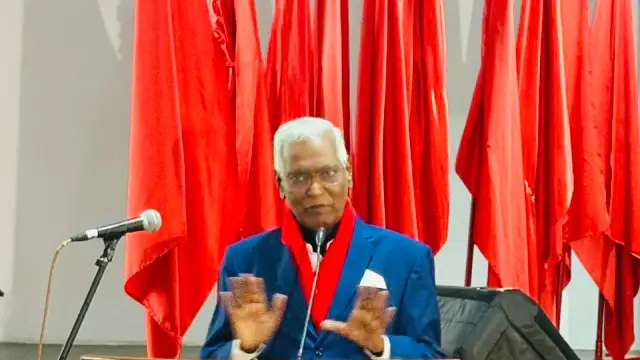
As the Communist Party of India (CPI) celebrates its centenary on December 26th, hoisting the red flag at Ajoy Bhavan in New Delhi and organising marches across states, it faces a major challenge in the subcontinent’s political landscape. While CPI’s national council’s general secretary, D Raja, highlights the party’s history and achievements in his speech, emphasising unity, questions arise regarding India’s communist movement.
With the party’s waning political influence and eroded organisational strength, it clings to the vestige of its glorious past. The party, once the principal opposition to Jawaharlal Nehru-led Congress government, made history by forming the world’s first elected communist government in Kerala under EMS Namboodiripad in 1957.
Though Nehru dismissed the Namboodiripad government, the CPI’s love for the Congress didn’t end. Probably this love has played a major role in the party’s decline, while the far-right managed to fill the vacuum created by the left’s weakness.
However, the CPI didn’t lose its steam merely for its unconditional love for the Congress, a party it considers the representative of India’s “national bourgeoisie”. There are numerous other reasons.
Scattered, hard to collect pieces
The CPI’s centenary celebrations also highlight the inner contradictions within India’s communist movement. While banners hanging outside the CPI headquarters, Ajoy Bhavan, proclaim a centenary, yet if three Indian communists were asked when their movement was born, three different answers would pop up.
The CPI insists on December 26th 1925, when roughly 500 delegates gathered in Kanpur during the Indian National Congress session. The CPI (Marxist) [CPI(M)], which split away in 1964, maintains that the true founding occurred on October 17th 1920, in Tashkent, where seven revolutionaries established a party under Comintern auspices. The banned Communist Party of India (Maoist), which rejects both parliamentary parties as revisionist, traces its lineage through the 1967 Naxalbari uprising and dismisses both dates as bourgeois historicism.
This disagreement over a birth date might seem like academic hair-splitting. It is not. The founding controversy encapsulates everything that has rendered Indian communism politically irrelevant at precisely the moment when inequality, labour precarity and democratic erosion should make left politics irresistible. A movement that cannot agree when it began has spent a century fragmenting into dozens of competing parties, each convinced it alone holds the correct revolutionary line.
Today, as Hindu nationalism consolidates power and the Bharatiya Janata Party (BJP) pursues what many term a “neo-fascist” agenda, India’s communists command just eight seats in a 543-member parliament. Among them, the CPI has only two. The far-right has captured the working-class vote that Karl Marx once promised would liberate humanity. Religious nationalism has filled the space vacated by class politics.
After the last party congress, Raja, the CPI’s general secretary, stood before journalists in New Delhi last September and issued what has become a ritual plea.
“India is passing through a very, very critical period. The BJP, RSS combine have captured political power. Using their electoral autocracy, they are trying to force great threats to our Constitution, to our democracy, to the federal system of government in our country,” he said.
“The need of the hour is Left and democratic unity,” he declared, warning that the BJP threatens India’s constitutional foundations.
This appeal isn’t new. Similar calls have echoed from communist platforms for decades. They are invariably ignored. The CPI(M), with four Lok Sabha seats, pursues its own “independent line”. CPI(ML) Liberation, which won two seats, maintains selective alliances while prioritising grassroots organising. The Maoists, conducting armed insurgency in central India’s forests, regard parliamentary communists as class traitors. Unity remains the perpetual aspiration and the impossible dream.
Understanding why requires examining not just the CPI’s century but the logic of fragmentation built into its DNA. This is a story of how revolutionary movements calcify into sectarian parties, how the perfect becomes the enemy of the good, and how the global left’s greatest weakness—its tendency to split rather than unite—has played out with particular tragedy on the Indian subcontinent.
If India’s communists cannot unite against fascism, what hope exists for the broader opposition?
Men who couldn’t agree, from beginning
The room in Kanpur where Indian communism was supposedly born no longer exists. The city has swallowed the site, replacing whatever structure stood there with the usual urban sprawl of northern India—concrete buildings, tangles of electrical wires, the constant honking of auto-rickshaws. No plaque marks the location. This obscurity seems fitting for a founding moment that even the participants disputed.
Singaravelu Chettiar, who chaired the conference on December 26th 1925, was already 53 years old—ancient by revolutionary standards. A Tamil Brahmin from Madras who had studied in Japan and embraced socialism after witnessing the Russian Revolution’s news reach Asia, Chettiar represented a particular type of early Indian communist— educated, cosmopolitan, influenced by global currents more than local conditions.
The conference elected him chairman and SV Ghate as general secretary, adopted the name “Communist Party of India”, and declared its aim of creating a workers’ and peasants’ republic. Approximately 300 to 500 delegates attended, though records from the period are fragmentary. Most were already active in communist groups operating in Bombay, Bengal, Madras and Lahore—cells that had formed organically in the early 1920s as news of VI Lenin‘s revolution spread.
But five years earlier and 2,500 miles northwest, a very different founding had occurred. Manabendra Nath Roy, a Bengali revolutionary who had fled British India after involvement in armed anti-colonial activities, found himself in Tashkent in October 1920. Roy had already established the Communist Party of Mexico in 1919 and participated in the Second Communist International, where he had debated Lenin himself on the correct strategy for colonial liberation movements. In Tashkent, Roy and six other Indian exiles constituted what they called the Communist Party of India, recognising it as the Indian section of the Comintern. Roy established a political school for Indian revolutionaries and authored manifestos to be smuggled into India.
The Tashkent group had legitimacy within international communist structures but almost no organic connection to Indian workers or peasants. The Kanpur conference had mass participation but occurred without Comintern sanction. Neither produced a complete party programme nor sustained a central organisation. As Harkishan Singh Surjeet, who led the CPI(M) for years, noted in 1993, perhaps neither date truly matters—only in 1930 was a Platform of Action announced, and a genuinely centralised party emerged only after the 1933 release of prisoners from the Meerut Conspiracy Case.
Yet the dispute persists because it represents competing visions of what a communist party should be. Is revolutionary legitimacy conferred by connection to international proletarian movements and ideological purity, or by organic growth from local struggles and mass participation? Should the party lead the masses toward correct consciousness, or should it emerge from existing movements? These questions, posed differently across the decades, have generated every subsequent split in Indian communism.
The irony, of course, is that neither founding produced immediate success. The CPI spent most of the 1920s and 1930s underground, its leaders cycling through British jails. The Peshawar Conspiracy Case, Kanpur Bolshevik Conspiracy Case, and especially the Meerut Conspiracy Case of 1929-1933 imprisoned virtually every prominent communist. The Meerut trial, which lasted four years and resulted in transportation sentences for 31 defendants, including SA Dange and Muzaffar Ahmad, paradoxically gave communism its greatest publicity. Newspapers covered the proceedings extensively. The accused transformed the courtroom into a platform for Marxist education, delivering lengthy statements explaining dialectical materialism and surplus value theory to bewildered British judges. By the time the prisoners were released, communist ideas had permeated Indian political discourse.
This success, however, came with a cost that would haunt the movement forever. Communism in India grew not through patient organising of workers and peasants but through the imprisonment and martyrdom of intellectual cadres. The party attracted educated urban radicals, not the proletariat it claimed to represent. When BR Ambedkar later criticised communist leadership as a circle of “Brahmin boys” unable to grasp the daily violence of caste oppression, he identified a class composition problem that persists today. The men arguing about founding dates in Tashkent and Kanpur were overwhelmingly upper-caste, urban, educated elites. The workers and peasants who would supposedly lead the revolution remained conspicuously absent from the argument.
Wounds that couldn’t heal
The photographs from the Calcutta Congress in October-November 1964 show two groups of men in white kurtas sitting in different sections of the Deshpriya Park pandal, pointedly not looking at each other. The CPI had called the Congress to resolve differences between what everyone euphemistically termed “rightist” and “leftist” factions. Instead, it produced the most significant split in Indian communist history. One faction, keeping the name CPI, would align with the Soviet Union and pursue reformist policies. The other, calling itself the CPI(M), would orient toward China and advocate sharper class struggle.
The split was years in the making, but the immediate trigger was something that had happened two years earlier on India’s northern border.
On October 20th 1962, India and China started fighting over their disputed Himalayan boundary, beginning a month-long border war that ended in a humiliating Indian defeat. The war forced Indian communists to choose between nationalism and international solidarity, between supporting the Nehru government and maintaining fraternal ties with Chinese communists. They could not do both.
Dange, the Bombay labour leader who had spent years in British jails and now led the CPI’s nationalist faction, immediately supported the Indian government. “The nation is under attack,” he declared. “Defence of the motherland is paramount.”
His faction argued that “Chinese aggression” was unjustified, that India’s territorial claims were legitimate, and that communists must support national defence even under a bourgeois government. This position aligned with the Soviet Union, which maintained neutrality in the conflict—a neutrality that tacitly supported India, given Sino-Soviet tensions.
Namboodiripad, P Sundarayya and other leftists saw it differently. They refused to subordinate working-class internationalism to bourgeois nationalism. The border dispute, they argued, was fundamentally about imperialism’s legacy—both India and China had inherited colonial boundaries drawn by the British. The left’s role was not to support the Indian capitalist state but to oppose war and maintain solidarity with Chinese comrades. They saw Nehru’s militarisation as an excuse to suppress domestic opposition and abandon democratic socialism for state capitalism.
The Nehru government responded by arresting approximately 1,000 communists in November 1962. The vast majority were leftists. Those detained included Namboodiripad, Jyoti Basu, P Sundarayya and AK Gopalan—virtually the entire left leadership. The rightist communists, who had publicly supported the government, remained free. Worse, evidence later emerged that right-wing CPI members had provided the Home Ministry with lists of leftists to arrest, effectively using state repression to settle intra-party disputes.
This betrayal made the split inevitable. How could leftists remain in the same party as people who had informed on them to a bourgeois government? On April 11th 1964, 32 members walked out of the CPI national council meeting. The Tenali Convention in July drew 146 delegates who gathered under a large portrait of Mao Zedong. The formal split came at the Calcutta Congress in October-November 1964, where 422 delegates—claiming to represent 60% of the original CPI membership—constituted the CPI(M).
The CPI(M) established itself quickly. In West Bengal and Kerala, most cadres joined the new party. In the 1967 general election, just three years after the split, CPI(M) won 19 Lok Sabha seats to the CPI’s 23. By 1980, CPI(M) had pulled decisively ahead, establishing dominance over the parliamentary left that it maintains today, despite electoral collapse.
But the split created lasting damage that transcends electoral scorecards. It established a template for how Indian communists resolve disagreements—not through debate, compromise and synthesis, but through accusation, expulsion and rival party formation.
The CPI(M) accused the CPI of “revisionism” and “class collaborationism”. The CPI accused the CPI(M) of “left adventurism” and “sectarianism”. Both were right. Both were wrong.
The actual issues—how to relate to the Congress party, whether to support the Soviet Union or China, what tactics suited India’s conditions—were complex questions admitting of multiple legitimate positions. Instead of tolerating that complexity within one organisation, Indian communism split into two parties, each claiming sole revolutionary legitimacy.
This pattern would repeat endlessly.
Every significant dispute would produce new parties.
The Naxalbari movement in 1967 would split the CPI(M). The newly founded party found itself accused of everything it had accused the CPI of.
In 1969, Darjeeling district’s communist leader Charu Majumdar, who led the 1967 Naxalbari uprisings, founded the CPI(Marxist-Leninist) [CPI(M-L)].
The party advocated armed struggle, prompting the state to unleash macabre atrocities targeting it.
The CPI(M-L) labelled both CPI and CPI(M) as “revisionists”. A trend that continued for the next five decades.
Indira Gandhi’s government didn’t spare the CPI(M-L). Operation Steeplechase used the Indian Army, paramilitary forces and local police to crush the rebellion. Majumdar was allegedly killed in police custody on July 28th 1972.
The first phase of the Naxalbari movement came to an end with his death.
Basu claimed in an interview with the foreign press that the government had arrested more CPI(M) activists, over 8,000, compared to over a thousand Naxalites.
Yet, the CPI(M) didn’t split, but the CPI(M-L) did. The party got fragmented into over 40 pieces. The CPI(M-L) Liberation later joined the parliamentary stream, along with others, while CPI(M-L) People’s War and Maoist Communist Centre finally merged to form the CPI(Maoist) in 2004.
The CPI was officially collaborating with the Congress government at that time. It has been since justifying its support for Gandhi, highlighting its achievements. Though the CPI opposed the human rights violations during Operation Steeplechase, it also made Indira take some strong steps.
The CPI’s support for the Congress ended pensions to the former princely states’ royal families. It led to the nationalisation of banking, insurance and mining industries. The CPI’s support to the Congress government, at the behest of Moscow, during the national emergency (1975-77), led to the inclusion of the words “Secular” and “Socialist” in the Constitution’s Preamble. A development that the BJP has been opposing even now.
The CPI(M) and the CPI(M-L) criticise Gandhi’s rule and the national emergency. They call her government autocratic. The assessment matches those of the Janata Party constituents, including the BJP.
The CPI doesn’t apologise for supporting Gandhi, making reunification practically impossible.
Hegemony collapses, left shrinks
While the CPI danced to Moscow’s tunes, the CPI(M) independently moved and managed to seize power in West Bengal in 1977.
Years later, the CPI would join its bitter foe, the CPI(M), as a junior partner.
The irony was quite telling. The parent party shrinks and joins hands with a splinter that has outgrown it. Joining an alliance with the splinter as a junior partner sealed the CPI’s fate.
The CPI(M) managed to stay afloat for a long time. However, since 2011, its downfall started. The Left lost West Bengal, which it had ruled for 34 years. In 2018, Hindutva surged, and the CPI(M)-led Left lost Tripura. The Left remains in power in Kerala, where the CPI remains a junior partner.
The Left’s loss in West Bengal is credited to its reversal of land reform policies and succumbing to neo-liberal economic prescriptions.
While Basu’s government enacted one of the largest land reform programmes of independent India, his successor, Buddhadev Bhattacharya, wanted to take a highway to industrialisation. The forcible land acquisition drive caused a rift between the Left and its traditional rural voters.
The Left paid a heavy price and lost the state in 2011. Although the Left won Tripura in 2013, they lost the state in 2018.
After the Left Front lost in West Bengal and Tripura, the CPI(M)-led bloc didn’t manage to make a comeback anywhere else, except Kerala.
The collapse was not merely electoral. It was organisational.
The CPI(M)’s once-formidable cadre structure, built over 40 years, disintegrated within a decade. Some cadres defected to the Trinamool Congress. Others joined the BJP, which rose from zero seats in 2011 to 77 in 2021—becoming the principal opposition in a state where it had never won a single assembly seat.
Two former CPI(M) legislators contested as BJP candidates in 2019; one won a Lok Sabha seat.
As a result, the CPI also lost its foothold in West Bengal and Tripura. As the CPI celebrates its centenary, it lacks legislators and members of Parliament from these two states.
The Left isn’t at peace in Kerala as well. In the 2024 Lok Sabha elections, the Left won just one of 20 Kerala seats despite governing the state. The BJP won its first-ever Kerala seat. The Left continued bleeding even in the local elections. The CPI is no exception.
The exceptionalism of the “Kerala model” may prove temporary.
After suffering setbacks, the CPI has trained its gun on the CPI(M) for its arrogance in West Bengal.
CPI calls for unity in centenary year
Raja’s call for left unity is not the first such call. It will not be the last.
The CPI has been pleading for left unity for at least three decades, with increasing desperation as electoral decline accelerated. In 1996, following the BJP’s brief first stint in power, the CPI convened an all-left conference proposing a common programme.
In 2004, after the Left’s best-ever electoral performance, CPI leaders again pushed for organisational unity, arguing the moment was opportune to build a single mass party.
In 2014, as the BJP swept to power under Narendra Modi, the CPI proposed a joint coordination mechanism. Each time, the response from the CPI(M) has been polite disinterest.
The CPI’s logic is straightforward. Together, the left parties might contest 100-150 seats without splitting the vote. A unified organisation could pool resources, present a coherent alternative to neoliberalism and Hindutva, and leverage its combined trade union and mass organisation membership.
Most importantly, unity would signal to voters that the communists represent a serious political force rather than a collection of quarrelling sects. The CPI insists that unity doesn’t mean merger, but means more than a mere electoral alliance.
However, for the CPI(M), it’s problematic. The CPI has been accusing the CPI(M) of arrogance and “big brother traits” in the broader left alliance. The CPI(M), meanwhile, has earned the arrogance by building a bigger organisation than the CPI, even amid a hostile situation.
The CPI also looks at the Naxal outfits, but to no avail.
Though the CPI shares cordial relations with the CPI(ML) Liberation, which has moved away from armed struggle to embrace parliamentary politics and grassroots mass movements, their unity is more symbolic at the grassroots.
“Red Salute to India’s great communist martyrs and fighters who have sustained the organised communist movement over these one hundred years in the face of every adversity and persecution. Let us summon all our strength to carry forward the communist mission in today’s challenging situation,” CPI(M-L) Liberation’s general secretary Dipankar Bhattacharya wrote on the CPI’s centenary celebration.
However, the Liberation, which has strong roots in Bihar and Jharkhand, won’t cede ground to the CPI in its strongholds.
The CPI(M) and other outfits didn’t even wish the CPI on its centenary.
Joint campaigns on farmers’ issues and labour rights have occurred. But the CPI remains deeply ambivalent about legitimising a party born from the Naxalite movement, which the CPI actively opposed in the late 1960s and early 1970s.
As for the CPI(Maoist), which continues armed struggle, the CPI’s position is vacillating. While the CPI, like the CPI(M), oppose the militancy advocated by the Maoists, it opposes state repression and alleged “fake encounters” of the banned outfit’s cadre.
The CPI has opposed the Modi government’s military push to suppress left-wing extremism. The party considers that the scope of the Union government’s anti-Maoist operations will eventually target the greater left-wing forces.
However, the Maoists have also not agreed to shun violence and join hands with the Indian parliamentary left. This creates a chasm. The far-right exploits it by pitting all sections of communists against each other.
Elusive unity pushes CPI to oblivion in centenary year
The structural impossibility of left unity in India reflects deeper contradictions in communist politics everywhere, but the Indian case illuminates them with particular clarity.
Consider what unity would require. The CPI wants ideological convergence around its positions. The CPI(M) wants hegemony over any alliance. Liberation wants organisational independence while coordinating on specific struggles. The Maoists reject the premise entirely. These positions are not compatible. Unity built on compromise would satisfy none of them.
These differences aren’t new. They have existed for decades. The Left doesn’t have a solution to this disunity.
However, at the same time, another organisation formed in 1925 has shown how to achieve unity and transform the state.
The Rashtriya Swayamsevak Sangh (RSS), the parental body of the BJP, also celebrated its centenary in 2025. However, unlike the CPI, it didn’t fragment. Rather, the RSS has become a giant organisation that has managed to sweep elections, one after another.
While the communists debate their differences at the micro level, the RSS has been uniting what it calls the Hindutva forces against the communists. The RSS has successfully projected the communists as “anti-national” forces in popular discourse.
The CPI and the broader left-wing camp realise this threat but can’t take decisive action.
As religious fundamentalism has become the driving force of Indian polity, the CPI has to look into the trajectory of other communist parties in the region.
The South Asian pattern reinforces the sense of futility.
The rise of religious fundamentalism in South Asia has weakened the communists. In Pakistan and Bangladesh, they have been rendered politically irrelevant.
However, in Nepal and Sri Lanka ruling communists tread carefully. In Nepal, warring factions have come together to form the Nepali Communist Party. In Sri Lanka, the Janatha Vimukthi Peramuna (JVP) returned like a phoenix. After losing all cadres and the entire leadership to state violence in the 1980s, the JVP swept the presidential and national elections in Sri Lanka. It shows light in the gloomy landscape.
In India, the communists remain disarrayed. They neither have the pragmatic approach of the JVP nor the parliamentary supremacy of the Nepali communists.
What lies ahead for CPI in centenary year
The CPI’s centenary celebrations today include speeches invoking unity against fascism. Raja called for left coordination. Except for Liberation’s Bhattacharya, none cared.
This outcome is not cynicism but recognition.
Left unity in India fails not because of personality clashes or tactical disagreements but because of structural incompatibilities built into how communist parties understand themselves. Parties that derive legitimacy from ideological correctness cannot unify without one party admitting incorrectness.
Yet the failure matters. The BJP’s consolidation of Hindu nationalist power represents the most serious threat to India’s secular democratic republic since independence.
Economic inequality has reached grotesque levels, with the top 1% owning more than 40% of wealth while rural distress produces mass farmer suicides. Climate change will devastate South Asia with particular severity; the subcontinent’s agriculture-dependent population faces catastrophe as monsoons destabilise and temperatures rise. India needs a credible left capable of addressing these challenges.
What it has instead is a fragmented movement controlling eight parliamentary seats, unable to convert movement participation into organisational strength. The CPI’s centenary raises questions without answers. Can the Left unite when its existence is in crisis?
The honest answer to all these questions may be no.
The CPI in its centenary year is not preparing for revival but managing decline. Its calls for unity are less programmatic than lament. The movement that shaped South Asia’s 20th century has become a footnote to its 21st. Understanding why requires examining what communists did wrong.
However, the bigger question is—who will bell the cat?
Communists in India love to remain fragmented.
The fragmentation and consistent erosion in support base have left both parliamentary and extra-parliamentary communists, the splinters of the CPI, redundant amid the RSS-led Hindutva camp’s spiralling rise. Yet, all parties will refuse the option of uniting and forming a strong Left to counter the far-right.
Amid this, most parties have seen a decline in recruitment, as the economy moves from organised to gig. Technological advances, the advent of artificial intelligence and robotics, and the growing reach of the far-right’s propaganda have caused major troubles.
Firstly, the communists don’t find the classical organised labour everywhere. Secondly, they can’t attract the youth, a large number of whom are gig workers, to their fold. Finally, they have no solutions to the challenges thrown by technology.
As communist parties suffer from ageing ranks and a lack of young blood, a big question looms over the fate of the red movement in India amid CPI’s centenary celebrations.
Whether survival is enough is a question the next hundred years may answer. For now, the CPI marks its centenary with the unity call that has defined it for decades—essential, urgent and deferred.

Unsigned articles of People's Review are fruit of the collective wisdom of their writers and the editors; these articles provide ultimate insight into politics, economy, society and world affairs. The editorial freedom enjoyed by the unsigned articles are unmatchable. For any assistance, send an email to [email protected]