
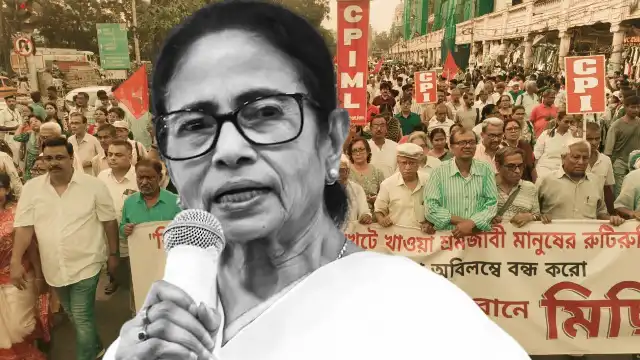
Mamata’s politics behind anti-BJP platform in West Bengal after TMC’s defeat
While the Bengali as well as the Hindi and English media across India remain preoccupied with the West Bengal Assembly election results and the swearing-in of Suvendu Adhikari as the Bharatiya Janata Party’s (BJP) first chief minister in the presence of Prime Minister Narendra Modi, on the other hand, former chief minister Mamata Bandopadhyay quietly organised an event to celebrate poet Rabindranath Tagore’s birthday near her residence, without much fanfare. Yet, from the stage of this very event, she put forward a proposal to shape a crucial political equation for the future. At this gathering, attended by several Trinamool Congress (TMC) legislators and supporters, Bandopadhyay openly called for the creation of a broad anti-BJP platform in West Bengal.
She extended this appeal not only to social and political organisations but also to Left and far-Left groups, urging a united struggle to “save West Bengal” and defeat the BJP.
This call is widely seen as an attempt to retain her anti-BJP positioning and assert herself as the principal opposition force.
Bandopadhyay puts Left and Congress under pressure
Although the Left and the Congress party in the state have openly welcomed the end of her 15-year rule, political analysts believe that Bandopadhyay’s invitation to join an anti-BJP platform places them in a difficult position.
The reason is straightforward: despite strong anti-incumbency, the Trinamool Congress secured votes from 26 million people in the state—something neither the Left nor the Congress can dismiss. In terms of seat share, the TMC now stands as the principal opposition party and is in a stronger position than it was after the 2006 elections.
Questions have been raised about how long Bandopadhyay can retain the loyalty of her 80 MLAs and her MPs—29 in the Lok Sabha and 13 in the Rajya Sabha—without defections to the BJP. However, she has signalled clearly that she is unwilling to shift from her political position.
As such, neither the Left nor the Congress party can write off the TMC as an anti-BJP force ahead of the 2029 Lok Sabha elections or the 2031 Assembly elections.
At the same time, if the Congress or the Left attempt to dismiss her call by invoking theories of “setting” (a tacit understanding with the BJP) or by highlighting her record of governance, they risk undermining their own anti-BJP credentials in the state—particularly among minority voters.
At the Tagore birthday event, her close associate and former journalist Suman Bhattacharya pointed out that the election results show that the combined vote share of the TMC, Congress, and the Left exceeds that of the BJP. Others echoed the view that all anti-BJP forces should therefore unite. How the Congress and the Left interpret this arithmetic remains to be seen.
The problem of remaining in opposition
Bandopadhyay’s remarks at the event make it clear that she intends to remain politically active on the streets under the banner of an anti-BJP platform. This could ensure that even if leaders close to Abhishek Banerjee defect, older, Mamata-loyal TMC leaders and cadres remain within the party.
However, serious questions arise regarding the economic sustainability of such a position.
Unlike cadre-based Left parties, a right-leaning formation like the TMC does not have a tradition of collecting funds from the masses. Data from electoral bonds in recent years indicate that the party’s primary financial engine has been large corporate donations—facilitated by its position in power.
Opposition parties in West Bengal have long alleged that TMC leaders and cadres amassed vast sums of money through corruption at the panchayat level by misusing state machinery. According to allegations from the Left, Congress, and the BJP alike, a portion of this money also flowed back into the party.
If the TMC remains in opposition, it will be cut off from these financial pipelines. This raises a crucial question: beyond a core group of ageing, ideologically committed Mamata loyalists, how many of those who joined the party after 2011—primarily to remain close to power—will stay?
What lies ahead for the Trinamool Congress?
The rise of the Trinamool Congress was rooted in anti-Left politics and a split from the Congress. Leaders from both the TMC and the saffron camp have acknowledged that the BJP had, at one stage, supported this rise.
After the fall of the Left Front, the TMC’s political identity became tied to being in power. Through governance, it attempted to remain relevant by alternating between narratives of central deprivation, Bengali sub-nationalism, and secularism, while retaining its vote base.
However, the absence of a consistent ideological position, combined with allegations of corruption and political violence, has in fact facilitated the BJP’s expansion in West Bengal. After 2021, Bandopadhyay’s adoption of a “soft Hindutva” approach—effectively mimicking the BJP—has further strengthened the saffron camp.
In this context, a key question emerges: can the 70-plus TMC supremo reinvent herself as a street-fighting opposition leader once again? Equally important is whether the Left or the Congress party would be willing to align with her while overlooking the allegations of corruption and violence associated with her tenure.
There is also the question of the TMC’s post-Bandopadhyay future. It is widely believed that after a significant number of leaders and cadres shift to the BJP, a large section of those remaining in the TMC may eventually join the Congress in her absence. Only a small faction may survive independently, similar to the Bangla Congress in the past.
In such a scenario, the Congress could ultimately find itself in a more advantageous position than the Left in West Bengal’s political landscape, and—much like after 2016—could emerge as the principal opposition force in a post-Bandopadhyay era by absorbing the TMC’s residual vote base.
At the same time, the BJP will continue to prefer a situation where Bandopadhyay’s TMC retains the position of principal opposition. This would allow the party to repeatedly invoke past allegations of violence and corruption, while consolidating Hindu votes through communal polarisation—thereby easing its electoral path over the next decade.
The immediate question, however, is whether Bandopadhyay’s call for unity among the Left, Congress, and other forces will receive any genuine response—or whether she will instead use this appeal to re-establish herself as the sole anti-BJP figure in the state.

Unsigned articles of People's Review are fruit of the collective wisdom of their writers and the editors; these articles provide ultimate insight into politics, economy, society and world affairs. The editorial freedom enjoyed by the unsigned articles are unmatchable. For any assistance, send an email to [email protected]