
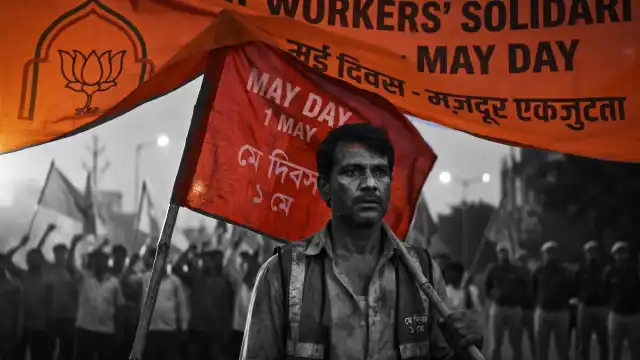
BJP appropriates May Day: Labour trouble beneath outreach
Amid intense debate over whether the Bharatiya Janata Party (BJP) can deliver its much-anticipated “change” in West Bengal, May Day has arrived. On International Workers’ Day, the Left raises the red flag, while parties such as the Trinamool Congress and the Congress—though hardly left-wing—extend greetings to workers and speak of harmony between labour and capital. Yet the BJP, guided by the ideology of its parent organisation, the Rashtriya Swayamsevak Sangh (RSS), once dismissed May Day as a “foreign” import, tracing its origins to Chicago, United States. That same party is now marking the occasion with messages of solidarity for workers.
This shift is not an instance of sudden ideological generosity; it reflects a deeper political necessity. The BJP’s new rhetoric around May Day is not about embracing labour politics, but about managing and containing it.
It is often argued that Left votes have gradually drifted towards “Ram”, that is, towards the BJP. Yet no one has seriously claimed that the BJP has developed any faith in the Left. In the recently concluded West Bengal assembly elections, BJP leaders—and even television anchors—openly appealed to the wavering middle-class supporters of the Left to vote for the BJP, framing opposition to the Trinamool Congress as the central axis of political mobilisation.
Why, then, has the BJP in West Bengal begun extending greetings on May Day immediately after the election? Why has it abandoned its earlier attempt to project Vishwakarma Puja as a “workers’ day”, only to now embrace May Day itself?
আন্তর্জাতিক শ্রমিক দিবসের শুভেচ্ছা। pic.twitter.com/Vtjv6NeaQz
— BJP West Bengal (@BJP4Bengal) May 1, 2026
This is not confined to West Bengal. At the national level, too, the BJP’s central leadership marked May Day, even as Prime Minister Narendra Modi refrained from mentioning it on social media, choosing instead to post about Maharashtra Day, Gujarat Day and Buddha Purnima. The reasons behind this apparent contradiction lie in recent political and economic developments.
राष्ट्र निर्माण में समर्पित सभी श्रमिकों को अंतरराष्ट्रीय श्रमिक दिवस पर कोटि- कोटि वंदन। pic.twitter.com/8p1BboqP76
— BJP (@BJP4India) May 1, 2026
Why the BJP wants to usurp May Day?
India’s economic reality provides the backdrop. Persistent inflation over the past few years has imposed sustained pressure on working people. Rising consumer prices have eroded real incomes: even where nominal wages have not fallen, purchasing power has declined. Questions of minimum wages, job security and the right to organise are no longer isolated concerns; they have become political questions.
The implementation of the four labour codes has further complicated matters. The government has argued that these reforms would simplify and modernise the labour market. In practice, however, they have heightened insecurity. Incomes remain unstable, employment is increasingly precarious, and the space for collective organisation has narrowed. A growing body of analysis suggests that the new labour regime privileges employers over workers, deepening distrust among the latter and giving economic discontent a sharper political edge.
For the BJP, the next major electoral battleground after West Bengal is the 2027 Uttar Pradesh assembly election. Before his retirement, Modi appears to have had two central political objectives: to establish a BJP government in West Bengal and to secure a renewed mandate for Yogi Adityanath in Uttar Pradesh. Equally important is the need to contain the anti-incumbency wave that was visible in the state during the 2024 general election. To that end, BJP and RSS cadres have been working on the ground since 2024, seeking to consolidate support well before opposition parties—particularly the Samajwadi Party—become fully active in the run-up to the election.
Yet an unexpected complication has arisen. The Left may be electorally marginal in Uttar Pradesh—barely visible even in places such as Kanpur, once a stronghold and the birthplace of the Communist Party of India—but its trade unions have demonstrated an ability to mobilise workers. In the industrial belt around Noida, adjacent to New Delhi, these unions have organised significant protests among workers battered by rising prices, demanding higher minimum wages and opposing labour codes that they argue strip away rights to organisation and secure employment. Noida is not just another industrial zone; it is a major contributor to Uttar Pradesh’s output and a critical node in its revenue system, attracting a substantial share of industrial investment owing to its proximity to the capital.
In April, the uneasy calm in this corporate hub was shattered. What began on April 10th as protests over minimum wages and large demonstrations soon escalated into direct confrontation between workers and the state–corporate nexus. Noida and neighbouring Faridabad in BJP-ruled Haryana turned into arenas of conflict. Around 1,000 workers were subsequently arrested, including leaders of Left trade unions and many long-time organisers who had worked quietly for labour rights.
Among them was Rupesh Roy, a Hindi-speaking auto-rickshaw driver living in Noida with his wife and children, and long associated with Left labour activism. Despite daily struggles with poverty, he had remained committed to his political work. The Noida police arrested him on charges of inciting labour unrest. Yet the timeline raises questions.
The movement turned violent on April 13th amid state repression, but Roy had been arrested two days earlier, on April 11th, from the Botanical Garden metro station in Sector 37. He had participated in a peaceful protest on April 10th, yet was later accused of instigating violence on April 13th. There are allegations that Roy was physically assaulted in custody. His brother has also been arrested. Police reportedly took Roy in chains to his home for a search, after which his wife and children had allegedly gone missing.
Subsequently, taking advantage of the administrative vacuum during the election period, Uttar Pradesh police arrested a young man, Aditya Anand, from Tiruchirappalli station on April 18th, branding him the “mastermind” of the Noida labour unrest. At the same time, claims surfaced linking the movement to Pakistan. Pro-BJP social-media influencers amplified narratives portraying labour protests as harmful to the nation.
Concealing realities: BJP’s poll strategy
The BJP has been equally careful to ensure that this repression does not alienate workers in West Bengal, whom Modi and his home minister, Amit Shah, have targeted politically. While blaming Chief Minister Mamata Bandopadhyay and the Trinamool Congress for the state’s fragile economy and expressing concern for migrant workers, the BJP has not once proposed raising the state’s minimum wage to match those in higher-paying regions. It has promised “one nation, one…” policies across domains—from rations to elections to pensions—but has made no attempt to introduce a national minimum wage.
Given that West Bengal and other eastern states supply large numbers of migrant workers to western and southern India, the BJP’s concern is clear: to prevent labouring populations from turning against it in response to events such as those in Noida and drifting back towards the Left. With the help of figures such as Samik Bhattacharya, projected as an “intellectual” voice, the RSS is now attempting to draw May Day—and labour politics more broadly—into the saffron fold.
This becomes even more significant in the context of opposition to the labour codes. Apart from the RSS-affiliated Bharatiya Mazdoor Sangh, most central trade unions have described the codes as anti-worker. The Samyukta Kisan Morcha (SKM), the joint platform of farmers’ movements across Punjab, Haryana and Uttar Pradesh, has also expressed solidarity with protests against them. The BJP understands that if trade unions and farmer organisations were to build a broad-based movement, it could pose serious challenges in the 2027 assembly elections in Uttar Pradesh and Punjab, as well as in the 2029 general election and the Haryana assembly polls.
आज 'मई दिवस' के अवसर पर 'श्रमेव जयते' की भावना को जीवंत करते हुए 'श्रमवीर गौरव समारोह 2026' का शुभारंभ तथा श्रमिक कल्याण की विभिन्न योजनाओं का लोकार्पण एवं शिलान्यास होगा।
— Yogi Adityanath (@myogiadityanath) May 1, 2026
हमारे श्रमिक भाई-बहन वह मौन शक्ति हैं, जिनके श्रम से सपने आकार लेते हैं और 'विकसित उत्तर प्रदेश-आत्मनिर्भर…
At the same time, consolidating influence over the working class in states such as West Bengal is crucial—not only to capture power there, but also to ensure that migrant Bengali Hindu workers do not participate in labour movements in northern and western India.
The BJP’s growing embrace of May Day must therefore be seen for what it is: not an expression of solidarity with workers, but a political defence. A day once rejected on ideological grounds is now being appropriated because it can no longer be ignored. May Day is not being accepted; it is being reshaped into a controlled symbol.
The question, then, is no longer about a single day. It is whether the historical meaning of labour struggle will be reduced to an instrument of political strategy, or whether it will reassert itself as an autonomous force. The future of May Day will depend on that answer.

Unsigned articles of People's Review are fruit of the collective wisdom of their writers and the editors; these articles provide ultimate insight into politics, economy, society and world affairs. The editorial freedom enjoyed by the unsigned articles are unmatchable. For any assistance, send an email to [email protected]