
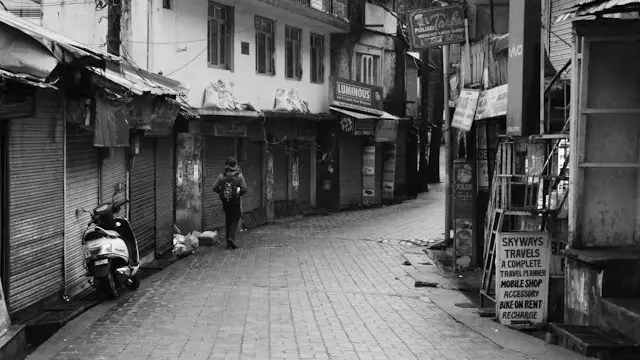
Civic sense in India: why streets shape behaviour
Videos go viral regularly: a tourist cleaning up garbage on an Indian beach, or a clean railway station in Tokyo set beside a dirty Indian one. Each reopens the debate over civic sense in India, and the comments follow a script. “Indians have no civic sense.” “Nothing will change till people change.”
Wrong question about civic sense
Civic sense can be seen as an individual choice, but it is treated as a national characteristic. Research suggests that people read their environment, draw conclusions about what is common in a given situation and react accordingly. The same person who drops a wrapper on a Delhi road may pocket it in Singapore. That response reflects two very different signals, not a split personality.
Squeeze on public space
India has more than a billion people on roughly one-third of the land area of the United States, and the density shows in its cities. The public realm has not kept pace. The World Health Organization (WHO) recommends nine square metres of green space for every city dweller, and many Indian cities have much less. Paths are obstructed, bins are too few or already full, and public toilets are rare. In a metropolis of millions, one missing bin means thousands of small decisions an hour pushed the wrong way. Little wonder civic sense frays.
What research says about civic sense
The most famous approach is the “broken windows” theory developed by James Q Wilson and George Kelling in a 1982 essay in The Atlantic: when something looks neglected, it signals that no one cares about it, and neglect spreads. The best evidence comes from a 2008 Science paper by Kees Keizer, Siegwart Lindenberg, and Linda Steg. In Dutch field experiments, graffiti and mess made people far more likely to litter, take a forbidden shortcut or even steal an envelope visibly containing money. Robert Cialdini’s work on social norms adds that people litter more in an already littered space. A street full of garbage is a social instruction.
Greenery matters too. Frances Kuo and William Sullivan found in 2001 that residents of Chicago public housing surrounded by trees showed lower levels of aggression than residents living amid bare ground. Anyone who has walked an Indian road in 40°C heat, without footpaths or benches, knows how quickly patience runs out.
How infrastructure becomes attitude
Combine these findings and the vicious circle behind weak civic sense emerges. The footpath is blocked and the bin is absent, so people walk on the road or leave their wrappers. The adaptation becomes normal, and since everyone does it, no one feels responsible. Attitude hardens into “why should I carry my trash when the municipality doesn’t care?” Authorities then feel little pressure to build anything, because citizens seem indifferent.
Commuters feel this daily as low-grade stress: dodging two-wheelers on the pavement, holding an empty bottle for an hour, crossing six lanes with no crossing. Much of what is blamed on character is partly a survival strategy in an environment that offered nothing better.
What comments reveal
Under videos comparing Indian and foreign streets, the same arguments recur. One camp insists that infrastructure is irrelevant and points to Indians littering in clean malls abroad. Another replies that they would gladly use a bin if one existed, and posts photos of overflowing ones. People who have lived abroad often describe how their civic sense changed: they began queuing and stopping at crossings without being told to. Fatalism – “nothing will ever change” – is itself a sign of the vicious circle. (These are paraphrased ideas, not verbatim quotes.) Both views contain some truth.
What other countries did differently
Comparisons with Singapore, Japan or the Netherlands are sometimes dismissed as unfair, since these countries are richer or less populated. Yet they prove that citizens can be taught civic sense. Singapore had enough bins, cleaning staff, plenty of street trees and fines that were always enforced. Japan has few public bins yet clean streets, because children clean their own classrooms and learn early to carry rubbish home, backed by reliable collection. None relied on moral lectures alone. India has often tried slogans without the matching physical systems.
Collective conscience: how civic sense is built
Cleanliness is a social convention: individuals keep a public place clean because they expect others to do the same, and because it also belongs to them. The assumption is fragile but can be strengthened. Indore, repeatedly voted India’s cleanest city in the Swachh Survekshan rankings, used door-to-door garbage collection, waste segregation, a respected sanitation workforce, penalties and citizen participation, until cleanliness came to be regarded as a source of local pride.
What needs to change for civic sense in India
First comes design: unbroken pavements, paired wet and dry bins emptied before they overflow, toilets, benches and shade in markets and bus stands, and street trees even in cramped neighbourhoods. Next comes consistent and fair enforcement, along with space and dignity for street vendors. Only then can the new norm be reinforced through school practices that maintain common areas and respect sanitation workers.
It is tempting to say that India’s public spaces are dirty because Indians do not care. The evidence suggests otherwise. In a densely populated country that gives its citizens little space, fewer bins, and inadequate shade, they are reminded every day that public spaces belong to no one. Change the signal and behaviour follows, as Indore has shown. Civic sense is not a gene. It is a habit, and habits are built by the streets people walk on.

I am a BTech Civil Engineering student at Vellore Institute of Technology. I am quite interested in the topics of infrastructure design, design psychology, and the relationship between public spaces and human behaviour, exploring how design influences everyday life and bringing an interdisciplinary perspective to questions of urban design and civic responsibility.