
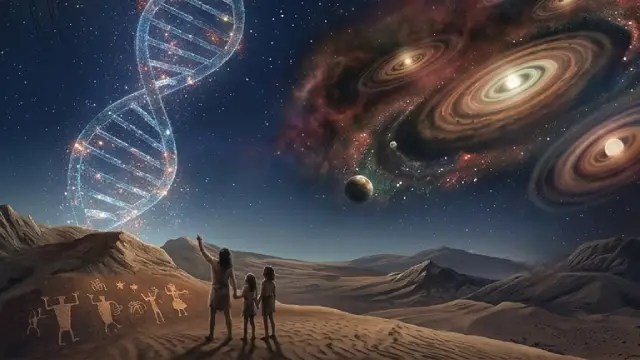
Elements in human body trace back to stars
The iron in the haemoglobin of human blood, like most elements in the human body, began its history long before Earth existed. Behind the ordinary biology of a beating heart, which pumps blood continuously around the body, lies an extraordinary cosmic story. Haemoglobin, present in red blood cells, carries the oxygen people breathe to the body’s tissues, and the processes that created the iron within it unfolded inside stars billions of years before the Sun came into existence.
In other words, the human body is not merely a biological system that evolved on Earth; it is also a natural wonder that carries the history of the universe within it, spanning billions of years. Where did the elements that make up human bodies originate? How did they travel from the stars to the Earth? What connects human blood to the universe? The answers begin billions of years ago, in the universe’s earliest stages.
Hydrogen and water: Big Bang’s legacy in human body
On average, water makes up about 60% of the human body’s weight. Water is a compound of hydrogen and oxygen, and both are inseparable from the history of the universe.
Most of the hydrogen in the human body formed during the early stages of the universe, after the Big Bang about 13.8bn years ago. The hydrogen in every person therefore connects to the earliest moments of cosmic history.
The story of human origins does not end with the Big Bang, however. The carbon, nitrogen, oxygen, calcium, phosphorus, sulphur and, above all, iron in the body owe their origins to another cosmic creator: the stars themselves.
Stellar nucleosynthesis: how stars forged elements
After the first stars formed, nuclear reactions in their interiors produced elements such as carbon, nitrogen and oxygen. These processes, along with other stellar and explosive events, contributed to the formation and distribution of many heavier elements. Scientists call this process of element formation inside stars stellar nucleosynthesis.
During their lifetimes, stars transform lighter elements into heavier ones through nuclear fusion. What a star can produce depends on its mass, temperature and evolutionary stage. The most massive stars can build up heavier atoms through successive stages of fusion, eventually reaching the iron group. When a star exhausts its nuclear fuel, it approaches the final stages of its life.
Supernovae scatter elements across space
Some massive stars end their lives in spectacular supernova explosions, scattering the elements forged during their lifetimes into space. Such stellar evolution and explosive events have played important roles in the cosmic history of elements such as calcium, phosphorus, sulphur and iron.
Over time, the material dispersed by these stars mixes with the surrounding interstellar gas and dust, becoming part of the raw material from which new stars and planets form. The Earth is one such planet. Matter dispersed through space long before the Earth existed eventually became part of the cloud from which the solar system formed. Later, through Earth’s formation and biological evolution, these elements became integral components of human bodies.
How Earth inherited its oxygen and iron
On the early Earth, much of the oxygen was chemically bound in water and rocks. Around 2.4bn years ago, oxygen released by photosynthetic microorganisms began accumulating in the atmosphere, a major transformation known as the Great Oxidation Event. Later, plants and algae also played crucial roles in producing and maintaining atmospheric oxygen. Stars forged oxygen; life on Earth helped transform the atmosphere into one that could sustain oxygen-dependent organisms such as humans.
Similarly, the Earth did not manufacture its iron from scratch. It inherited iron formed through the lives and deaths of stars that existed long before the Sun was born. Iron is essential for carrying oxygen in the blood: the haemoglobin molecules in red blood cells contain iron, which binds to oxygen in the lungs and transports it to tissues throughout the body.
The iron flowing through human veins today therefore has a history extending across billions of years of cosmic evolution. Matter forged in stars travelled through space, became part of the material that formed Earth, and eventually found its way into human bodies.
Looking at stars, remembering origins of elements in human body
Some people may fear water; others may fear fire. But perhaps few living beings feel fear when looking at a sky filled with stars. Instead, gazing into the vastness of the cosmos can evoke a profound and almost spiritual experience. Perhaps the reason is that the atoms in the human body also trace their origins to the universe.
Made of elements forged in the cosmos, people may look to the stars and unknowingly remember their own origins. Humans are not separate from the universe. They are part of its ancient story – a story written in the stars and carried within them.

A veterinary professional, science writer, and nature enthusiast from Andhra Pradesh, India. His writing explores science, astronomy, biodiversity, and humanity's relationship with the natural world.