
All Muslims are terrorists: Children fall prey to bigotry
The Bharatiya Janata Party (BJP) and several Hindu nationalist organisations have opposed the admission of 42 Muslim students to Vaishno Devi Medical College in Jammu and Kashmir. The BJP MLA from Udhampur wrote on social media: “Institutions built from donations by devotees of Shri Mata Vaishno Devi must operate in a manner that fully reflects the temple’s sanctity. Amendments to the Shrine Board Act and University Act are now imperative.”
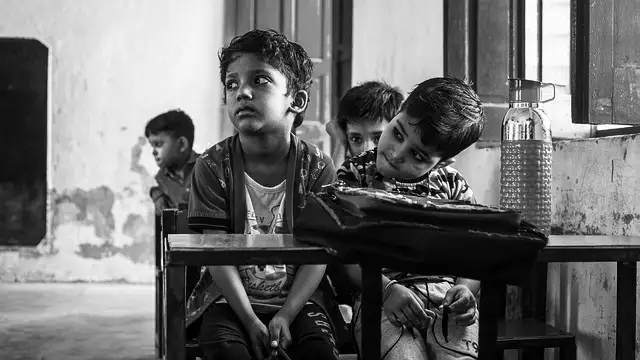
This brings to mind an incident from a few days earlier. An NGO worker, visiting a school for work, heard directly from pupils: “Muslims are terrorists.” The social worker also heard: “Your home is in Kolkata? That place is full of Muslims.” The school is in Tripura, which the BJP governs. One detail merits attention: the speakers were eight to ten years old. The seeds of communalism have been planted in these children’s minds from their earliest years.
The question is: where does such thinking originate? At an age when children should be learning to ride bicycles, playing hide-and-seek, kho-kho or cricket and football with their peers, how is such religious fundamentalism and hatred taking root in the minds of a large section of today’s children?
History reveals that such sentiments existed earlier in Bengali literature and culture. The writings of many immortal writers, from Bankim Chandra Chattopadhyay to Sarat Chandra Chattopadhyay, have at various times expressed ambivalence about Muslims.
Bankim wrote: “Brother, will such a day come when we shall break mosques and build temples of Radha-Madhav?” Bhavananda’s voice declares: “If we don’t drive out these opium-eating shaven-heads, what remains of the Hindu’s Hinduness?”
Sarat Chandra, meanwhile, states in his novel Srikanta: “Today there is a football match between Bengalis and Muslims.” This suggests that even Sarat Chandra hesitated to accept Muslims as Bengali.
Dig deeper, however, and the other side of the coin emerges. The history of communal harmony in Bengal is not rare either. Dinesh Chandra Sen said in a lecture: “Bengal’s common people are not Jains, not Buddhists, not Christians, not Muslims, not Hindus—they are Bengalis.”
This makes clear that while conflict and animosity existed between the two religions in certain cases, coexistence and tolerance also prevailed in full measure. Consequently, this conflict never became disgraceful.
One may mention an essay by Kshitimohan Sen in this context. He wrote: “It is true that pilgrimage sites and temples and various sacred places were repeatedly endangered by Muslim attacks, but religion’s chief abode—the heart’s temple—gradually began to awaken.”
Standing in the present moment, the biggest question is: why is this picture of tolerant India slowly sinking into the depths of oblivion? What exactly are the political reasons behind it? The answer is not particularly difficult.
A few years ago, at an election rally in Jharkhand, Prime Minister Narendra Modi said that those protesting against the Citizenship Amendment Act could be identified by their clothes. One need not be a political analyst to understand which community Modi was indicating.
When his party seeks to establish that prime minister as a “model” for the entire country, it goes without saying that a vast number of people will be influenced by him.
In truth, if ordinary citizens can be kept away from the country’s real problems, the ruler’s purpose is served. And if this work can be done from early childhood, all the better.
When the country’s population from eight to eighty is busy ignoring hunger to bomb Pakistan, what is new? Thus, one horrific rape after another, unemployment, the endless patronage of Adani and Ambani with government support, Delhi’s pollution—to divert attention from all this, there is one weapon: label a particular community as terrorists, create tension at the border, deliberately force the country’s people to think that people of that particular community are your enemies.
Accomplish this much, and you can rest easy.
Professor Sanjay Mukhopadhyay, formerly of Jadavpur University, says on this matter, “Earlier, despite many conflicts, a kind of social bond existed. Recent politics has torn that bond apart. The history of twenty-first-century Bengalis is actually a history of separation. Children are also falling victim to this.”
He adds, “From pre-school level onwards, children are being told not to mix with, not to play with, that friend from that particular community. Don’t give him notes. Naturally, that child becomes biased. The serious consequences become visible as he grows up.”
Consider this carefully, and one understands the statement is not wrong. The entire game plan has been arranged with considerable thought.
Syllabuses are being changed. Two years ago, the NCERT syllabus dropped Mughal-era history, the women’s movement and Darwin’s theory. Accusations arose at the time that these changes were made to give shape to the saffron camp’s specific agenda. Though nothing came of it.
Subsequently, writings by many authors from Rabindranath Tagore to Mahasweta Devi have been dropped, replaced by writings of Ramdev or Yogi Adityanath. In other words, children are learning propagandist history from the start; from literature to science, in every field, they are forgetting to ask questions. That is, exactly what the ruler wants is happening.
Alongside this, one cannot deny that a large section of parents nowadays has established the false notion that Muslims are this country’s enemies, accompanied by fake news from “WhatsApp University”. Children are paying the price.
Alongside politics, the current social situation is also responsible for this. Psychologist Aparna Chakraborty says, “Nowadays, parents should be more conscious. In the rat race of competition, today’s children are already forgetting how to be friends. If they come second instead of first, frustration takes root in their minds. And from that frustration, in some cases, children become excessively aggressive.”
“Therefore, parents must be more careful. Children must be made to understand that clothes and food habits do not create obstacles to friendship,” Chakraborty adds.
According to psychologist Debanjan Bhattacharya, “The responsibility lies entirely with the child’s parents. They themselves often speak such hate-filled words. Children are quick learners, so they also learn these things. Even when attempts are made later to correct the mistake, it is not possible most of the time. The attitude of disdain towards a particular religion or community persists.”
Today’s Bengalis and indeed all Indians stand at the brink of a terrible catastrophe. Identifying a community, restricting their daily lives, imposing prohibitions on food habits under the pretext of religion, and above all, branding an entire community as terrorists—this amounts to an effort to erase that particular community from the country’s soil and from people’s minds. We too are unwittingly becoming entangled in this, as are the children in our homes or the neighbouring house. Therefore, beware.