
Mamata’s unity call against BJP meets Left scepticism in West Bengal
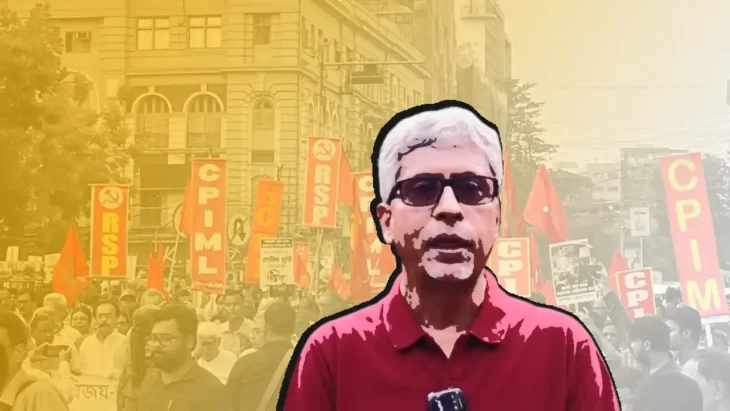
The Communist Party of India (Marxist-Leninist) Liberation, or CPI(ML) Liberation, which contested the 2026 West Bengal Assembly election as part of the Left Front, has openly questioned Mamata Bandopadhyay’s proposal to the left to form a broad platform against the Bharatiya Janata Party (BJP) and her political credibility.
Standing at a programme organised on the occasion of Rabindranath Tagore’s birthday last week, former West Bengal chief minister Bandopadhyay accused the BJP, which recently swept to power in the state, of turning the provincial election into a “farce” and called for a united movement against the saffron camp. She invited Left and ultra-Left forces to join that platform.
But while far-right leaders globally — from US President Donald Trump to British MP Bob Blackman — congratulated the BJP on its West Bengal victory, the state’s Left forces remained reluctant to respond to Bandopadhyay’s appeal.
Although Bandopadhyay spent much of her 15 years in office attempting to establish herself as the sole anti-BJP force in the state, Left parties repeatedly accused her of tacit understandings with the BJP. That history has now made them deeply suspicious of her latest call for unity.
In an interview with People’s Review, CPI(ML) Liberation’s West Bengal state secretary, Abhijeet Mazumdar, said Bandopadhyay must first apologise for the corruption and governance failures during her tenure before any joint movement against the BJP could be possible.
“Mamata Bandopadhyay essentially came to power by appropriating the Singur and Nandigram farmers’ movements during the final years of the Left Front,” Mazumdar said. “And we have characterised her 15 years in office — particularly the third phase of her rule — as a period of misrule. Because of all-pervasive corruption, social terror, and the entire structure that developed under her government, we called it a regime of misgovernance.”
CPI(ML) Liberation questions Mamata Bandopadhyay’s credibility
Mazumdar said the Left had identified the BJP as a “fascist force” long before the election, and had attempted to defeat both the saffron camp and Bandopadhyay’s Trinamool Congress (TMC) politically.
“Today she has suddenly been removed from power, and a completely fascist government has come to office,” he said. “So certainly, even from a textbook political standpoint, Left and democratic forces must unite. There is no confusion or hesitation on that question.”
“But before that,” he continued, “Mamata Bandopadhyay must publicly admit what happened under her government. Twenty-six thousand teachers lost their jobs because of corruption. Education ministers and food ministers were jailed. Justice was denied in the RG Kar hospital rape and murder case, where her government allegedly spent millions trying to obstruct the investigation midway. A ‘syndicate regime’ of loot was created. The decentralised democratic structure of the panchayat system was destroyed. She should publicly apologise for this misrule.”
Mazumdar argued that without such an admission, Bandopadhyay’s appeal could not simply be accepted at face value.
“How can she assume that merely because she makes a call, the Left and democratic forces will rush to stand beside her?” he asked.
When asked what kind of apology CPI(ML) Liberation expected from Bandopadhyay, Mazumdar replied: “The primary condition has to be that she acknowledges wrongdoing and mistakes, and apologises to the people of West Bengal. That is the most basic issue. To fight fascism, the Left must unite along with democratic forces.”
“Otherwise,” he added, “how can it work that she suddenly makes an appeal and the Left immediately joins hands with her against the BJP? Politics does not work like that. Situations evolve gradually. I think this is the basic precondition.”
Lessons from Singur and Nandigram
Mazumdar drew parallels with the Left Front government’s refusal to admit mistakes over land acquisition in Singur and Nandigram before its defeat in 2011.
“When the Left Front lost power in 2011, we said that the government never admitted its mistakes over forcibly acquiring thousands of acres of agricultural land in the name of industrialisation,” he said. “There were killings as well. But the Left Front government never acknowledged those mistakes.”
CPI(ML) Liberation had itself remained outside the CPI(M)-led ruling establishment during the Left Front years and participated in anti-government platforms at the time.
Ahead of the West Bengal election, the party had also strongly opposed the Special Intensive Revision (SIR) of electoral rolls, particularly after similar exercises in neighbouring Bihar. Even after the process began in West Bengal, CPI(ML) Liberation repeatedly expressed concern over it.
Mazumdar alleged that the BJP’s sweeping majority was not merely the result of anti-incumbency against Bandopadhyay’s government, but also of deeper institutional manipulation.
“Using the entire state machinery and communal politics, the BJP has come to power,” he alleged. “At the same time, it is also true that there was strong anti-incumbency against Mamata Bandopadhyay’s government. That was a major reason for her removal from office.”
TMC lost anti-BJP credibility
Asked whether TMC still retained any credibility as an anti-BJP force in West Bengal politics, Mazumdar said: “As of now, no.”
“Outside West Bengal, she may still have some image,” he said, referring to endorsements from leaders such as Akhilesh Yadav. “There was a perception that she could stop the BJP in Bengal. But what were the conditions for that resistance? If politics is reduced only to cash transfers, then the Modi government is now promising to double those benefits.”
“At some point,” he argued, “people begin to feel that if they are getting Rs 1,500 as a right, they might as well vote for the one promising Rs 3,000 instead. Such welfare politics can create a success narrative once, but it cannot sustain one indefinitely.”
Mazumdar repeatedly returned to the need for political self-criticism.
“Our central argument is that there must be introspection about the 15 years of her government,” he said.
“The Left’s task is not backroom compromise”
Mazumdar insisted that the Left’s primary responsibility was not to strike an understanding with Bandopadhyay across the table merely to oppose the BJP.
“The Left’s task is not simply to sit across the table with Mamata Bandopadhyay and reach an arrangement to fight the BJP,” he said.
He accused both the BJP and TMC of reducing West Bengal politics into a bipolar contest while issues such as unemployment, inflation and workers’ rights disappeared from public discourse.
“For the Left,” he said, “the real question is whether farmers are receiving fair prices for their crops, whether workers will be crushed under the labour codes. Mamata Bandopadhyay herself must answer whether she opposes these labour codes. Her government has already drafted state labour rules extending the working day from eight hours to ten and a half hours. From that position, how can the Left immediately join hands with her?”
Mazumdar also accused Bandopadhyay of failing to match rhetoric with action.
“She spoke about opposing the SIR process but could not stop it,” he said. “For four years, the 100-day rural employment scheme remained suspended. Certainly, we blame the BJP government for deliberately withholding funds. But it is equally true that corruption took place in those funds.”
He cited the RG Kar case, the school recruitment scandal and the killing of student activist Anis Khan as examples of public anger against the previous government.
“A climate of social terror had spread across West Bengal,” Mazumdar alleged. “Certainly, through the SIR and through state institutions, especially under the Modi government, the electoral process itself has been distorted. We are not saying this was a pure reflection of public opinion. But we also cannot ignore the large anti-incumbency sentiment.”
Can Mamata Bandopadhyay resurrect TMC like 2006?
Although the BJP won the election comfortably, it did not produce a collapse on the scale of the Left Front’s 2006-to-2011 decline. The TMC remains the second-largest bloc in the Assembly, with Bandopadhyay now serving as leader of the opposition.
Asked whether her political return remained possible, Mazumdar argued that the current situation differed fundamentally from 2006.
He warned that the BJP rule would sharply shrink democratic space in West Bengal.
“The clearest example is Tripura,” he said. “After coming to power there, the BJP first ended pensions for government employees and eliminated the jobs of more than 3,000 teachers. Even today, Left party offices — not only CPI(M) offices but ours as well — have been attacked and burned.”
“In Agartala,” he continued, “if anyone attempts an anti-government street meeting, motorcycle squads arrive within 15 minutes like Nazi stormtroopers, smashing microphones and physically attacking people.”
Mazumdar warned that the BJP would gradually impose similar authoritarian measures in West Bengal, though perhaps through different methods.
“This government will leave no democratic space,” he said. “West Bengal is different, so they may proceed more gradually. Bulldozer politics will come here too, though perhaps not immediately. But I think it is impossible for Mamata Bandopadhyay to return to the role she occupied in 2006. The greater responsibility now lies with the Left in rebuilding democratic mass movements in West Bengal. And this time, a heavy price will have to be paid. It will not be easy.”
Still, he maintained that “a Left and democratic unity is absolutely necessary to fight fascism”.
The Bihar comparison
In neighbouring Bihar, CPI(ML) Liberation is part of a broader anti-BJP alliance alongside the Rashtriya Janata Dal (RJD), Congress and other Left parties.
When asked why a similar arrangement could not emerge in West Bengal — especially given the RJD’s own history of corruption allegations and past conflict with CPI(ML) Liberation — Mazumdar stressed that Bandopadhyay had yet to prove her credibility.
“We are trying to unite all Left forces and take that message to the people,” he said. “The struggle must focus on restoring the basic conditions necessary for people to survive with dignity and rights. Mamata Bandopadhyay has not yet proven her credibility on these questions. In fact, she stands on the opposite side. She still has a long road ahead.”
He argued that Bihar’s political structure was fundamentally different because the BJP there still depended on coalition allies such as Nitish Kumar.
“In West Bengal,” he said, “the BJP has secured absolute power on its own. That means preparing to bulldoze all democratic rights entirely.”
Mazumdar also expressed alarm over remarks made by the BJP’s new chief minister, Suvendu Adhikari.
“The person they made chief minister openly delivers extreme hate speech,” he said. “Even journalist Prannoy Roy remarked that in his 33 years of journalism, he had never heard such hate speech. The chief minister is openly saying Muslims are no longer needed, that there is no need for a minority ministry because minorities have already received too much. Isn’t that frightening?”
He concluded by reiterating that Bandopadhyay would have to rebuild political trust before any future cooperation became conceivable.
“She is now in the opposition and still has substantial legislative strength,” he said. “Let her fight that battle first. Then we will see what happens in the future,” he added, indicating scepticism.

An avid reader and a merciless political analyst. When not writing then either reading something, debating something or sipping espresso with a dash of cream. Street photographer. Tweets as @la_muckraker