
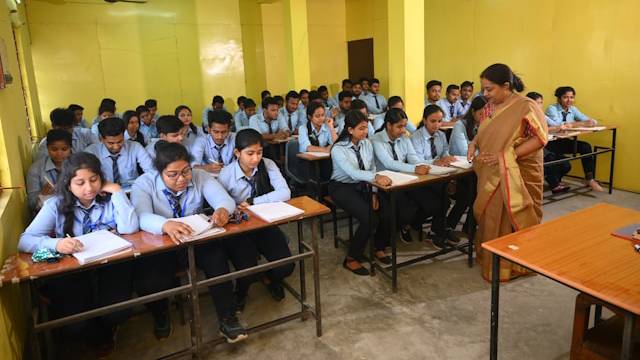
Secondary education can’t remain secondary in India
India has the world’s largest youth population. But India will waste this demographic advantage if millions of young people cannot access education beyond Class 8. Over the last decade, especially after the Right to Education (RTE) Act, 2009, policymakers have focused strongly on improving enrolment and completion at the elementary level. That effort has certainly helped expand access. However, policy attention to secondary schooling has been highly uneven. While a few states have done exceptionally well in improving enrolment and completion, many others are still struggling with low enrolment and even lower completion rates at the secondary or higher secondary levels.
One of the biggest reasons behind low participation in secondary schooling is the shortage of affordable government schools. According to the Unified District Information System for Education (UDISE) 2024-25, only 20.85% of schools in India have secondary or higher secondary classes. In some large states, the situation is even worse. Uttar Pradesh (UP) and Bihar have only around 13% of schools offering secondary or higher secondary schooling. This means that for many students, continuing education after Class 8 becomes difficult because no affordable secondary school is available nearby.
The shortage of government secondary schools has also changed who provides education. UDISE unit-level data clearly shows this shift. Overall, 23.09% of schools in India are private unaided, that is, fee-charging schools. But when the analysis narrows to secondary and higher secondary schools, the share of private unaided schools rises sharply to 43.83%. The same trend is visible in student enrolment. While 38.8% of all school students study in private schools, at the secondary or higher secondary level almost half of all students (49%) enrol in private unaided schools.
This clearly shows that as children move to higher classes, they increasingly depend on private schools because the public system is simply not available in many places. Even when it is available, parents send their children to private schools due to a lack of quality and accountability in government schools. Thus, for many families, this is not a choice but a compulsion.
The picture becomes even more concerning in some states, particularly UP. Around 70% of secondary and higher secondary schools in the state are private unaided schools, the highest proportion in the country. This is not just because private schools expanded rapidly, but also because the UP government has not invested enough in building and strengthening public secondary schooling. Unlike primary schools, opening secondary schools was never seen as an attractive political investment, and it required much higher public spending.
Understanding this trend requires examining how the state organises secondary schooling. Secondary schooling in the state has been provided through three types of schools: government schools, which are fully owned and funded by the government; government-aided schools, which are privately managed but receive government funding mainly for teachers’ salaries; and private unaided schools, which are completely fee-charging and receive no government support. However, after 1986, the state largely stopped extending grant-in-aid status to new schools because of the rising fiscal burden of financing secondary schooling. As a result, the government neither expanded its own schools nor the aided sector, leaving secondary schooling largely in the hands of private unaided schools.
This is not a recent trend. For decades, the state has approached secondary schooling with limited public investment and an increasing reliance on private institutions. Private schools are growing so fast that UP is the only state in India where the share of private unaided secondary or higher secondary schools in rural areas is higher than in urban areas, according to UDISE 2024-25.
The state’s budget priorities also reflect this neglect. UP allocated only 9% of its Samagra Shiksha budget for secondary schooling in 2025-26, the lowest share among states. Even more worrying, in 2024-25 the state spent only around 36% of its total allocation for secondary schooling. Despite these challenges, UP still lacks a dedicated policy for secondary schooling. This highlights how little attention the state has given secondary schooling.
Why does growing privatisation matter?
The growing dependence on private schools also raises an important question about affordability. As the government schooling system remains weak or limited, families must spend more on education. This creates a huge financial burden, especially for poor and marginalised households. Education beyond the elementary level, thus, slowly becomes something that depends on the family’s ability to pay rather than the student’s willingness to study.
At the same time, paying private school fees does not automatically mean better quality. The literature does not clearly support the widespread perception that private schools always perform better than government schools. In UP, PARAKH Rashtriya Sarvekshan 2024 finds that in private unaided schools, students scored 8% lower in Language, 4% lower in Mathematics, and 5% lower in Science and Social Science than the national average for Class 9. The high proliferation of private unaided schools in the state, therefore, does not translate into student competency levels comparable to the national average. These findings challenge the widespread assumption that private schools automatically provide better-quality education, at least in the context of UP.
The assumption that private schools provide better-quality education becomes difficult to support when comparing the socio-economic backgrounds of students in government and private institutions. Government schools often perform better than commonly assumed. Much of the apparent advantage of private schools stems from the fact that they enrol students from relatively better-off socio-economic backgrounds. Consequently, school type alone cannot explain differences in learning outcomes, since students come from vastly different backgrounds.
The absence of a strong government secondary school system has also created another problem. Low-fee private schools have expanded rapidly to fill the gap left by the state. This vacuum has also encouraged the growth of unrecognised schools and dummy schooling, where students enrol in one institution but appear for board examinations through another recognised school. Such practices have become a consequence of the weak public system rather than isolated cases.
Even after the launch of the Rashtriya Madhyamik Shiksha Abhiyan (RMSA) in 2009, which aimed to expand secondary schooling across the country, UP continued to rely heavily on private provisioning. Without a clear policy, adequate public investment and proper implementation, this dependence on private schools has increased year by year.
Secondary schooling cannot continue to remain secondary in policy priorities. If India wants to benefit from its young population and prepare them for future opportunities, access to affordable and quality secondary schooling has to become a central concern. Otherwise, the gains made in elementary education will end after Class 8, forcing millions of young people either to drop out or into an increasingly unequal private education system.

Sunit Singh works as a Project Assistant at the Centre for Social and Economic Progress. The views are personal.