
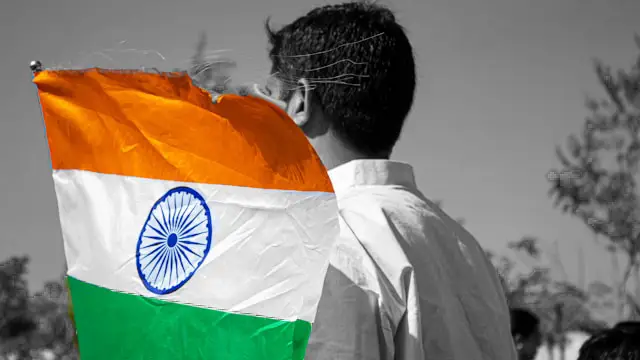
Independence Day: ‘Azadi’ continues to haunt Modi’s BJP
As Prime Minister Narendra Modi pushes to successfully conclude his “Har Ghar Tiranga” (a national flag atop every house) campaign marking India’s 80th Independence Day on August 15th, his far-right Bharatiya Janata Party (BJP) stands accused of attacking “Azadi” — the Urdu word for freedom — after it became a political slogan used by left forces and other opposition groups.
Modi’s BJP-led government had itself launched a campaign titled “Azadi Ka Amrit Mahotsav” (the elixir of independence) in March 2021 to mark the 75th anniversary of India’s independence, and designated the period between 2022 and 2047 as “Amrit Kaal” (the auspicious era). Yet the government and the ruling party have consistently reacted with hostility whenever their opponents use “Azadi” as a slogan.
The latest flashpoint over the term — which first triggered a national storm during the Jawaharlal Nehru University (JNU) students’ protest in 2016 — surfaced during a 36-day protest by students at New Delhi’s Jantar Mantar against repeated examination paper leaks. The protest’s organisers, the internet meme movement Cockroach Janata Party (CJP), had barred the use of “Azadi”, but several students and protesters raised the slogan regardless.
Seizing on these instances, India’s mainstream media — much of it accused of favouring Modi and the BJP — labelled the young protesters, commonly termed “Gen Z,” as “anti-national” and “foreign-funded,” echoing the ruling establishment’s familiar playbook.
Despite the BJP’s hostility to the term, “Azadi” has steadily gained currency across the country since 2016 — a problem for a party that opposes the word for both historical and political reasons.
Azadi’s roots remain problematic
The BJP has marketed “Azadi Ka Amrit Mahotsav” with considerable fanfare, which makes its opponents’ use of “Azadi” doubly awkward for the party.
The slogan’s origin troubles the BJP and the wider Hindutva camp led by the Rashtriya Swayamsevak Sangh (RSS). It has its roots in the Kashmir valley, a UN-recognised disputed territory and a longstanding flashpoint between nuclear-armed neighbours India and Pakistan. “Azadi,” or freedom, became the central demand of the mass movements that swept the valley in the late 1980s and early 1990s, accompanied by a surge in militancy.
Roughly translated, the chant “Hum Kya Chahte? Azadi” — “What do we want? Freedom” — challenges India’s authority over the disputed territory, making it anathema to the RSS-led Hindutva camp. The same slogan returned to Kashmir’s streets in 2016, when the BJP was a junior partner in the state’s coalition government with the People’s Democratic Party (PDP). Hundreds of protesters, including children and women, suffered pellet-gun injuries as security forces put down the demonstrations by force.
That same year, the slogan resurfaced far from Kashmir, at JNU in the capital, causing the BJP considerable embarrassment. The party’s coalition with the PDP collapsed by 2018, when President’s Rule was imposed on the former princely state, but the slogan continued to haunt the BJP and RSS.
Suppressing protest by force has proved easier in Jammu & Kashmir, especially after the region was stripped of its special constitutional status in August 2019. But “Azadi” returned to the streets again later that year, during nationwide protests against Modi’s contentious citizenship law. That movement also internationalised the slogan, linking it to concerns over the treatment of Muslims in India and creating fresh difficulties for Modi’s government.
Azadi’s concept stirs trouble
Beyond Kashmir, an improvised version of the slogan — demanding freedom from hunger, poverty, caste and class oppression, and patriarchy — poses a deeper challenge to the BJP and RSS’s core beliefs.
Hindutva doctrine rests on unconditional faith in a hierarchical social order rooted in Brahminical tradition. It demands obeisance and discourages questioning authority at any level, from the family to the state; authority is treated as supreme, unchallengeable and unaccountable. Critics argue that this refusal to be held accountable — among other regressive features of the doctrine — is precisely what the Modi government has become.
The BJP rejects this charge, pointing to the resistance offered by its predecessor, the Jan Sangh, and the RSS when Indira Gandhi, then prime minister, imposed a national emergency in 1975. But critics say the party’s actions since suggest a longer-term ambition to entrench an authoritarian model in Indian politics.
The left, meanwhile, has adopted the Kashmiri “Azadi” slogan while dropping its underlying demand for the right to self-determination. Even so, the BJP accuses the left of conspiring to break up India, citing an alleged pro-secession chant raised during the 2016 JNU protests. The video purporting to show the chant was later found to be doctored, but the BJP and pro-government media have continued to press the allegation of sedition.
Because the left is the RSS-led Hindutva camp’s principal ideological adversary, the BJP, the Modi government and sympathetic media outlets continue to vilify those who invoke “Azadi” to demand socio-economic liberation for India’s working class. The left has tried to counter the BJP’s narrative and its allegations of a “tukde tukde gang” (a gang seeking to break India apart), but critics say these rebuttals rarely reach a wide audience, drowned out by television anchors and social media influencers aligned with the government’s line.
Whither Azadi?
Even as Modi’s government celebrates “Azadi Ka Amrit Mahotsav” and casts the run-up to the centenary of independence as an “Amrit Kaal,” critics point to a parallel erosion of citizens’ rights over the same period.
In June 2023, at an event in Andhra Pradesh, Modi described the period leading up to 2047 as a “Kartavya Kaal” — a period of duty — during which citizens should focus on their fundamental obligations rather than their rights. He had made a similar point in January 2022, telling an Azadi Ka Amrit Mahotsav event that an excessive focus on rights had weakened the country over its first 75 years of independence.
These remarks are not isolated. They sit alongside repeated comments from BJP parliamentarians and leaders who have described Modi in terms befitting a monarch and citizens as his subjects — language critics say points to a BJP-RSS project to entrench authoritarian rule while weakening the opposition, the left and the Congress party. International studies have found that civil rights and democratic space in India have contracted during Modi’s tenure, lending further weight to the allegation.
The BJP dismisses these concerns, pointing instead to its record in office and predicting it will govern India unopposed for decades. But with growing unease over the independence of the judiciary and institutions such as the Election Commission, the opposition fears India risks losing the freedom it won from colonial rule in 1947 — a freedom secured through a protracted struggle the RSS chose not to join.
The question now is whether the BJP’s discomfort with “Azadi” as a political slogan will push the party toward greater consolidation of power and authoritarian rule, or whether India can hold on to the democratic spirit it won through decades of anti-colonial struggle.

Unsigned articles of People's Review are fruit of the collective wisdom of their writers and the editors; these articles provide ultimate insight into politics, economy, society and world affairs. The editorial freedom enjoyed by the unsigned articles are unmatchable. For any assistance, send an email to [email protected]