
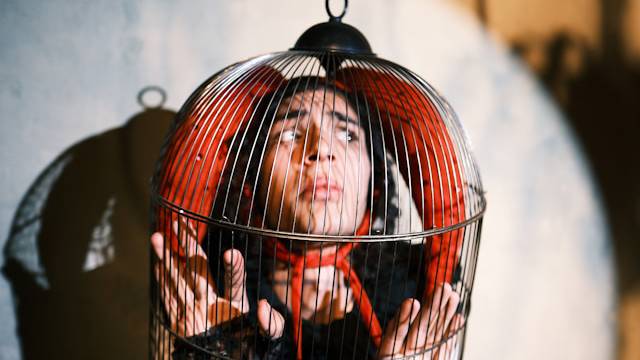
Cage called freedom: Who is really free?
Every morning, an alarm goes off. Not because the body has decided it has had enough sleep, but because there is somewhere to be — a class, a workplace, an examination, a meeting. Before the eyes are properly open, many reach for their phones. A few notifications, a message, a little scrolling, and then a glance at the time: already late.
And the day begins.
Days are spent studying, working, replying, scrolling, competing and trying to keep up. Schedules are made to become more productive. Sleep, steps and calories are tracked. Grades, careers, salaries and followers become sources of worry. Even rest can carry a quiet guilt — the sense of not doing something useful.
Nobody stands over anyone with a whip. Nobody forces people to check their phones every few minutes. And yet, somehow, they do.
This is what makes modern freedom so strange. People have become remarkably good at controlling themselves.
More than a century ago, Max Weber noticed a profound transformation taking place in modern society. Human life was increasingly being organised around calculation, efficiency, discipline, predictability and control. Weber called this process rationalisation. As rationalisation spread through modern institutions, people increasingly found themselves living according to systems they had helped create but could no longer easily escape. This is what lies behind his famous image of the “iron cage” in his celebrated work, The Protestant Ethic and the Spirit of Capitalism. He could not have imagined smartphones, algorithms or social media. Yet his idea of the iron cage seems strangely familiar today.
Cage that Weber saw
For Weber, modern capitalism was not simply about money or markets. It required a particular kind of human being: disciplined, punctual, calculating and willing to organise life around work.
Traditional ways of living were gradually giving way to a world where time could be measured, work could be optimised, and production could be calculated.
The question slowly changed from “How much do I need?” to “How much can I produce?” Weber connected this transformation to what he called the spirit of capitalism. Earlier, religious ideas could give disciplined work a moral and spiritual meaning. Work could be understood as a calling, and self-discipline as a virtue. But eventually, the religious justification faded while the system remained the same. People continued to work, compete, save and calculate not because they believed these things were morally meaningful, but because the economic order demanded them. And this is where the iron cage appears: people work because they need money. They need qualifications because they need employment. They compete because they need security. They become productive because they cannot afford to fall behind. The system does not always need to force anyone from outside. Its demands come to be carried inside instead.
The cage has changed
The iron cage of Weber’s time was built largely through capitalism, bureaucracy and rational organisation. Today, technology has given it another form. Phones know how long their owners sleep. Watches count steps. Applications measure productivity. Social media turns attention into numbers. Workplaces track performance. Algorithms learn what people watch, what they click and what keeps them engaged.
More and more of life can now be measured. And once something can be measured, it can be compared: how many marks? How much money? How many followers? How many hours worked? How productive was today?
The modern world constantly offers numbers by which to judge a life. And this can quietly change the question people ask about their own lives. Instead of “Am I living well?” the question becomes “Am I doing well?” The difference is enormous.
Technology has undoubtedly expanded human freedom. People can communicate across continents, access almost limitless information and accomplish things previous generations could hardly imagine. But technology has also made something deeply human into a commodity: attention.
An algorithm does not need to order anyone to keep scrolling. It simply offers another video. Another notification. Another recommendation. People choose to stay. And because they choose, it feels like freedom. That is what makes the new cage so difficult to see.
When people become their own managers
Perhaps the most intimate part of the iron cage is what it does to a person’s relationship with themselves. People are constantly told to improve: improve the body, improve the career, improve communication, improve productivity. Become the best version of yourself.
There is nothing wrong with improvement. The problem begins when people start treating themselves as machines that are never efficient enough. They stop simply living and start constantly managing themselves. Even rest becomes a strategy: rest so work can be better tomorrow; exercise so productivity can continue; skills are learned so employability increases.
And somewhere beneath all of this is a quiet fear: what if I am falling behind?
Nobody has to say it any more. People tell themselves. This may be one of the most powerful forms of modern control: when external expectations become internal desires.
Disenchantment
Rational organisation has produced science, modern medicine, technology, large-scale institutions and extraordinary productive power. The problem begins when efficiency becomes the measure of everything. Because not everything valuable can be measured. A conversation between friends has no productivity score. A poem has no economic necessity. A walk does not need a destination. Love cannot be calculated. Grief cannot be optimised. A moment of silence does not have to produce anything. And yet, the modern world increasingly asks: what is this useful for?
And that is where Weber’s idea of disenchantment becomes relevant. As the world becomes more rationalised, more things become calculable and predictable. Understanding grows, measurement grows, and control grows. But knowing how something works does not necessarily explain why it matters.
Science can explain how the heart beats. It cannot explain why the death of someone loved can make the whole world feel empty.
Humanity has become extraordinarily good at answering how. But the question of why refuses to disappear.
It would be easy to make technology the villain here. But that would miss Weber’s deeper point. The problem is not technology itself. It is not even capitalism itself. The problem is what happens when one logic becomes the logic of everything.
Efficiency is useful in a factory. But should friendship be held to the same standard?
Calculation is useful in business. But should every relationship be calculated according to what it yields?
The question is not whether this cage can be escaped. Perhaps it cannot, and perhaps it should not be escaped entirely. The question is whether people can remain human inside it. Can technology be used without letting it define desire? Can work continue without turning existence entirely into productivity? Can rest happen without guilt? Can something be done simply out of love, even when it has no economic value?
Perhaps freedom today is not merely having more choices. It may also be the courage to question the forces shaping those choices.
To put the phone away. To sit in silence. To read something without asking what it will do for a career. To spend an evening with someone without checking the clock. These may seem like very small acts. But perhaps they are reminders that people are human beings, not machines waiting to be optimised.
More than a century after Weber wrote about the iron cage, its bars have changed. They may now be made of algorithms, deadlines, metrics, notifications, competition and personal expectation.
The cage does not always look like oppression. Sometimes it looks like convenience. Sometimes it looks like success. Sometimes it looks exactly like the life one thought they wanted. And perhaps that is what makes it so frightening.
The most dangerous cage is not the one that prevents escape. It is the one whose bars become so familiar that they stop being noticed.
So, perhaps the question of this age is not simply whether people are free. It is whether, in the attempt to make life more efficient, they have forgotten what life was meant to be for.

A student of Arabic Literature and Political Science at Jamia Millia Islamia, New Delhi. I write about contemporary social and political questions from a Gen Z perspective.