
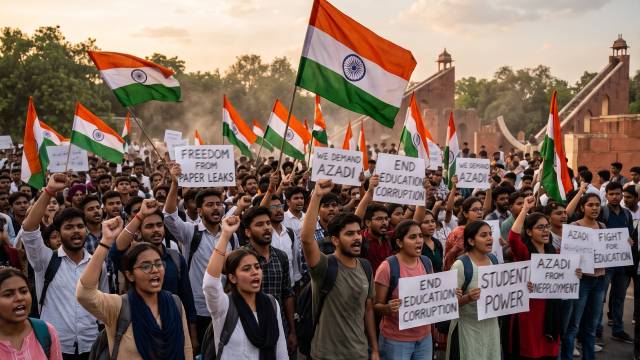
CJP protest, Pradhan’s resignation: New public sphere rises
Former Union education minister Dharmendra Pradhan’s resignation cannot be seen only as one event in a public uprising or simply as a minister’s resignation. The Bharatiya Janata Party (BJP) is known for avoiding political accountability and rarely removing ministers from their positions. But this time, the Cockroach Janata Party’s (CJP) protest at Jantar Mantar forced a union minister to resign. This itself makes the event politically significant.
The important point is that the protest was not led by any political party or traditional pressure group. It was a youth public uprising of a new generation. It reflected the growing disappointment among the youth against a government that has increasingly abandoned its young people. The National Eligibility cum Entrance Test (NEET) paper leak was one of the events that triggered this anger, and social media became the main channel through which youth from different backgrounds converged around their shared dissatisfaction with the government. Different issues, which earlier looked isolated, slowly came together into a larger public dissent.
The CJP was not simply the result of the chief justice of India’s remarks. His comment on the youth only became the moment through which an already existing public dissent got formalised. The dissatisfaction was already there, but it couldn’t organise itself earlier, mainly because the mainstream media failed to provide any space for it. Social media is increasingly doing the job the media is supposed to do. The mainstream media has committed two major crimes. First, it has removed public dissent from the public sphere. Second, it has created a separate world of propaganda that hardly exists on the ground.
As Jürgen Habermas argues, the public sphere emerged in Europe during the late seventeenth and especially the eighteenth century, alongside the rise of capitalism, civil society and the bourgeois class. As trade expanded and institutions such as printing presses, newspapers, coffee houses, salons and reading societies developed, educated private citizens began to meet and openly discuss political, social and economic issues. These discussions were based on reason, criticism and debate. In this way, the public sphere became a space between the state and civil society where citizens could form public opinion and hold governments accountable. For Habermas, this bourgeois public sphere became a central feature of modern democracy.
However, today the print media and television media have largely failed to produce such a public sphere where critical discussion can actually happen. Instead of encouraging rational debate, they have increasingly become instruments of propaganda and political management. This is one of the major reasons why public dissent remained suppressed for so long. The dissent never disappeared; it only went underground because there was no platform where it could openly express itself.
The public sphere was being colonised by state power or market interests. Instead of rational critical debate, the media started manufacturing consent under state and market pressure.
However, the rise of social media, despite all its own problems and limitations of misinformation, algorithmic amplification and emotional polarisation, has opened a new space for public debate and political discussion. It has become a new kind of public sphere where young people can express anger, share experiences, and build collective opinion outside the control of traditional media institutions.
What emerged on social media should not be seen as the replacement of the mainstream public sphere but as what Nancy Fraser called a counterpublic. Youth who were excluded from television debates and newspaper discourse created an alternative communicative space where grievances could be articulated and shared. In Fraser’s language, this became a subaltern counterpublic challenging the dominant public sphere.
In many ways, social media has begun healing the rotten public sphere by bringing political discussion back into the public domain. The resignation of Pradhan, therefore, should not only be understood as the fall of a minister. It should also be seen as an indication that a new public sphere is emerging, one shaped by the youth and mediated through digital platforms rather than traditional media institutions.
Pradhan’s resignation therefore represents more than the resignation of a minister. It marks a moment when dispersed individual frustrations crystallised into a politically conscious public. Whether this develops into a durable democratic public sphere or remains only a temporary digital mobilisation will depend on whether these new communicative spaces can sustain critical debate beyond moments of protest.

Sunit Singh works as a Project Assistant at the Centre for Social and Economic Progress. The views are personal.