
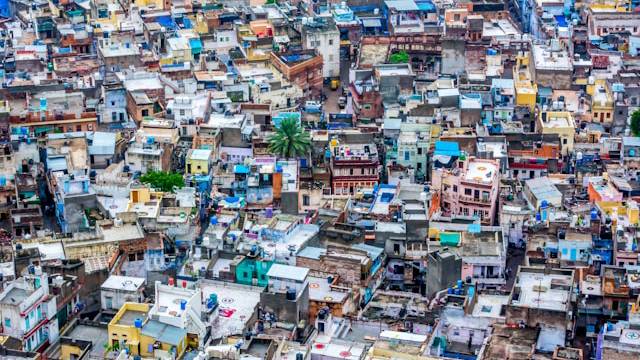
India is growing; its affordable housing isn’t
Economic development has long been considered one of the clearest indicators of a developing nation. Since economic development brings higher incomes, industrialisation and more job opportunities in cities, it seems reasonable to believe that quality of life will automatically improve. However, this holds a paradox in many of India’s fast-growing cities: even as their economies expand rapidly, obtaining good, affordable housing is becoming harder and harder. Why does housing remain inaccessible despite being one of the basic necessities?
The housing crisis in India is much more than unaffordable apartments. This is an issue of urbanisation, inequality, employment, land, infrastructure and policy development, all at once.
Indian cities have become centres of economic activity. People prefer moving to cities because they can find jobs, colleges, firms, and other facilities. As more and more individuals relocate to urban areas, it is only natural that demand for homes would increase. The problem is that housing supply neither grows fast enough nor stays within reach of the ordinary person’s budget. Recent estimates reveal that India faces an urban affordable housing shortage of about 9.4m units, which could grow much larger with further urbanisation.
Thus, a classic supply-and-demand problem emerges: many people want to live close to their workplaces, but affordable housing is scarce, so housing prices rise. In India, housing prices have risen sharply in recent years, creating difficulties for families who already spend a large share of their income on accommodation. However, it’s not just market dynamics. The type of houses built also matters. Businesses are motivated by incentives. In the case of luxury and premium housing, which generates higher returns on investment than affordable housing, private investors often opt for the former. Recent debates on the Indian housing market have highlighted that affordable housing may be less lucrative for developers, given its high cost structures and low margins.
This is where the difference between economic growth and economic development comes into play. Economic growth simply means an expansion in an economy’s production and income levels. Economic development, however, encompasses much more. It involves improvements in people’s quality of life and their access to basic needs and opportunities.
Therefore, a city could be economically prosperous but not necessarily liveable.
Consider a young professional. A new technology firm might offer a well-paid job in cities such as Bengaluru, Gurugram and Mumbai. That person benefits from securing the job; however, when a substantial share of the salary goes towards rent, a higher income no longer translates into a higher standard of living. For domestic workers, delivery workers, factory workers and other low-paid workers in cities, the problem is even more severe.
Housing affordability, therefore, is directly linked to inequality. Average income levels may rise, but the benefits of development may be unfairly distributed. Rising gross domestic product (GDP) says nothing about whether that additional income actually reaches people struggling with rent, congestion and insecure housing. That is why development should not be measured through national income alone.
There is also a structural side to the matter. India’s economic opportunities are concentrated in a handful of urban centres. If more jobs are available, more workers will be drawn to the area. As a consequence, both housing demand and prices will rise. At the same time, cheaper housing tends to be available only in areas relatively remote from these sources of employment. And this brings another cost: transport.
The fact that a cheaper house can be found far from the workplace becomes largely irrelevant once transport costs are taken into account. Thus, housing policy needs to be connected with employment and infrastructure policy.
The government clearly has a part to play here. India has made significant efforts through initiatives such as the Pradhan Mantri Awas Yojana-Urban (PMAY-U). By August 2026, the government reported that more than 10m houses had been built and handed over under the initiative. But building houses is only part of the task; where these houses are located, how good they are and how accessible they remain matter just as much.
There has also been extensive discussion about the need to free up land and reform urban planning policy to enable affordable housing. Through such initiatives, it would become easier for developers to build housing for low- and middle-income groups instead of focusing on the higher end of the market.
Thus, the solution cannot lie in simply building more houses. India needs more affordable houses in the right places. This would require proper public transport, balanced urban development, easier access to land, prudent zoning laws, affordable rental housing and incentives for affordable construction. Smaller cities and new employment hubs could also be promoted, spreading economic opportunity beyond a handful of expensive metropolitan centres.
India’s growth story is real, but ultimately, growth should be judged by how it benefits people in their everyday lives. People do not experience growth as a percentage change in GDP. They feel it in their wages, commuting times, access to good healthcare and education, and, above all, in their ability to afford decent housing.
The problem of housing affordability thus highlights a crucial limitation of growth without inclusion: people are forced to travel farther to work, spend too much of their income on rent, and even live in poor conditions, just to remain part of the growing urban economy.
A city cannot be considered developed merely because its real-estate values are rising. What matters is whether those who build and sustain the city can actually afford to live in it.