
From student voice to political instrument: CJP’s changing face
The term Gen-Z generally brings to mind a specific generation. In contemporary India, however, it has taken on broader social and political meanings. Young people are becoming more vocal about education, employment, competitive exams and accountability in institutions. An important question is emerging: who is shaping this youth voice, and whose interests does it serve? The rise of the Cockroach Janata Party (CJP) serves as a key example.
What started as a controversy over calling young people “cockroaches” gradually grew into a broader digital expression. A meme that popularised the phrase “Cockroach Janata Party” turned satire into a shared identity for many young people. For a generation already frustrated with education and competitive exams, it became a new way to mobilise youth. However, students’ anger did not originate with the CJP. Allegations of paper leaks, exam irregularities, and administrative failures in exams such as the National Eligibility cum Entrance Test (NEET), the Staff Selection Commission (SSC), Uttar Pradesh Police recruitment, and various state Public Service Commissions (PSCs) had already built considerable frustration. For students who spend years preparing for exams, the system’s credibility is crucial to their future. Their anger, therefore, cannot be dismissed as merely a social-media trend.
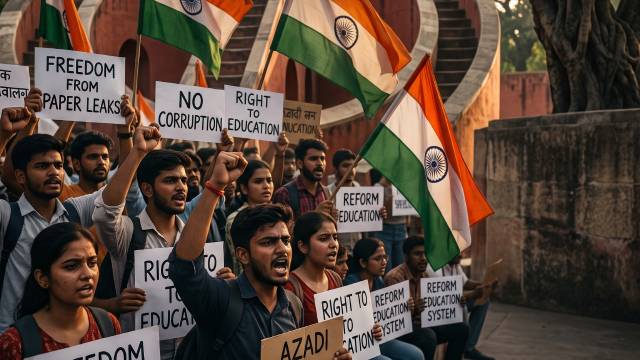
Against this backdrop, the protests at Jantar Mantar, including hunger strikes and Satyagraha-related activities, brought student issues into the public spotlight. The protests also faced confrontation and police action, including lathi charges, raising concerns about how student protests are managed. Additionally, questions arose about the political nature of the movement. CJP had organised a protest that was not meant to be affiliated with any political party. However, the presence of flags and symbols from certain student organisations, along with political slogans about Umar Khalid, stirred controversies. This does not automatically mean the whole movement was politically controlled. Political involvement in student movements is neither unusual nor wrong. The key issue is whether this involvement changes the character of a movement that claims to represent students independently of political parties.
The difference is between political participation by students and political control over a student movement. Political groups can support valid student demands, but concerns arise when original issues – like exam transparency, education reform and accountability – get overshadowed by broader political goals. The same question applies in Jharkhand, where protests over alleged exam irregularities, such as those involving the Jharkhand Public Service Commission (JPSC), and the resulting police actions have again highlighted student grievances. CJP’s reliance on virtual support, rather than a stronger on-the-ground presence, raises questions about its effectiveness as a youth advocacy group.
The debate surrounding CJP reflects a larger shift in India’s youth politics. Gen-Z is becoming more politically aware, digitally connected and willing to challenge institutions. However, this growing influence also attracts established political organisations looking for new supporters and ways to mobilise. CJP thus faces a crucial decision. It can either become an independent advocacy group representing young people’s concerns while keeping away from partisan interests, or it can become more entwined with established political organisations and their campaigns. The real question is not just whether CJP is political; any movement dealing with governance and public policy is political in a broader sense. The real issue is who directs its political aims and whose interests shape its agenda.
For India’s Gen-Z, this may be the most important question of all. A generation seeking to challenge the system must also ensure its voice does not become someone else’s tool.
Will CJP remain a platform through which students speak to power, or will it become a political instrument for power to speak through students?
In essence, the changing dynamics of CJP raise an important question: an organisation formed to voice the concerns of students and young people on matters like exams and employment now appears to be functioning amid the patronage and support of various political organisations. Questions also remain about the background of CJP founder Abhineet Dipke, who apparently had links with the Aam Aadmi Party in the past. Moreover, the organisation’s meagre response to the ongoing controversies about the JPSC has further increased scrutiny of CJP’s current functioning. In light of this, there are doubts about whether an organisation formed to voice the opinions of students and young people has started viewing students’ problems selectively through a political lens.

Mayank Jha is a political science student and writer based in Delhi. Born in Bhagalpur, Bihar, he graduated from the University of Delhi’s Sri Aurobindo College and is pursuing postgraduate studies in Political Science through IGNOU. His areas of interest include Indian politics, democracy, public policy, youth issues, education, and contemporary political events. Through his writings, he seeks to offer a critical perspective on the political and social issues shaping India.

Anju Kumari is a political science student and writer based in Delhi. Born in Rajasthan, she graduated from the University of Delhi’s Sri Aurobindo College and is pursuing postgraduate studies in Political Science. Her areas of interest include Indian politics, democracy, public policy, youth issues, education, and contemporary political events. Through her writings, she seeks to offer a critical perspective on the political and social issues shaping India.