
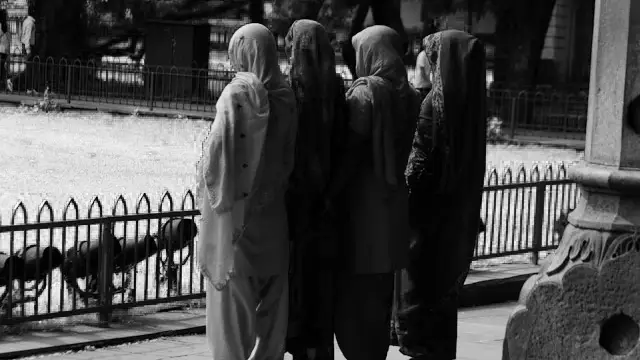
Why women cannot loiter in public spaces in Delhi
Only men get to loiter in public spaces in Delhi, and I have watched it happen from the edge of one low stone wall for years.
The wall rings a park in Green Park, South Delhi, and I have walked past it for years without once sitting on it. It is the retaining wall of an old tomb, possibly from the Mughal period or later. It is one of the many nameless ones the city has absorbed so completely into the neighbourhood that most residents could not tell you which century it belongs to or whose tomb it is. By late afternoon, when the winter light turns golden orange and loses its warmth, the wall catches the sun at exactly the angle that makes it worth sitting on. A man is usually there. Sometimes several, spaced along its length as if they have agreed not to sit too close. A newspaper folded under one arm, a phone in hand, a cigarette perhaps, or nothing at all. Just a man on a wall, watching the park the way you watch a park when you have nowhere particular to be and no one is going to ask you why.
I have never seen a woman sit there. Not once, in the last three years of walking past.
It is not about one wall
This is not a claim about that wall alone. It is a claim about almost every wall like it in this city. Every retaining wall around an unnamed monument or historic ruin, every ledge outside a colony market, every bench in every park built by the Delhi Development Authority (DDA) and used by exactly half the population it was built for. I know this because I have spent a professional life reading cities, noticing sightlines and thresholds and the heights at which walls stop being barriers and start being seats. I also know it because I have spent my personal life watching what happens when a woman tries to do what that man on the wall does without a second thought: nothing. Just be there. Just occupy space without giving it a reason.
Why loiter?
Shilpa Phadke, Sameera Khan and Shilpa Ranade wrote the book that gave this idea its name, Why Loiter?, in 2011. The question they ask is deceptively small. “Why can a man loiter and a woman can’t? Not walk somewhere, not run an errand, not move through a space with a destination stapled to her but to be just still in public, unproductively, the way idleness is supposed to work.” Their answer, in short, is that women in Indian cities are allowed conditional access to public space. This access is granted only when justified by purpose, by escort, by haste, by the right clothes at the right hour. Loitering has no purpose by definition. That is what makes it loitering. And that is exactly why it is not offered to women as an option, least of all in Delhi. The city’s reputation for being unsafe has become so total that it now does the work of the wall itself, keeping women moving, keeping them purposeful, keeping them explained.
I think about this every time I design something. I do not set out to build exclusion into a plan, and nobody does, or nobody admits to it. But the absence is easy to miss. A retaining wall gets specified for its height, its relationship to the monument it holds up and the load it needs to bear. Nobody writes “for men only” into the drawing of these walls. Nobody has to. The exclusion is not in the section. It is in what happens after the section becomes a place, in the thousand small social transactions that decide, park by park and colony by colony, who gets to sit down.
The wall does not change, the questions do
What is strange is how little the physical object has to do with it. The wall does not change. Its width is the same at five o’clock whether a man or a woman sits on it. What changes is entirely social, in the questions a woman on that wall would be asked, silently or not, that the man never is. What are you doing here? Who are you waiting for? Why aren’t you somewhere else? And in Delhi specifically, is it getting dark? A woman sitting still becomes a small emergency that needs explaining. A man sitting still is furniture, indistinguishable from the tomb he is leaning against.
I used to think the fix was architectural: better lighting, more benches, and sightlines that make a park feel safe rather than exposed. Delhi has tried some of this, park by park and colony by colony, and I still think it matters. I have spent enough of my working life arguing for it to mean that. But I have started to think the deeper problem sits somewhere lighting cannot reach. You can floodlight a park until it is safer than a hospital corridor, and a woman sitting alone on a wall in it will still be read as unusual, still be read as waiting for something, still be denied the one thing the man gets for free. That assumes she is allowed to be there without a reason, without an escort, and without the sun already halfway down.
No tidy resolution
I do not have a tidy resolution for this, which is probably the most honest thing I can say about it. I could write that the fix is more women reclaiming these walls, more of them simply sitting down until it stops registering as strange. There is something to that, the slow social work of repetition, of making an unfamiliar sight familiar by sheer volume. But I am wary of putting that weight on individual women, as if the burden of unmaking a spatial order should fall on the people it was built to exclude, in a city that already asks them to carry so much of their own safety. That is the same old trick in a new costume. It tells women that the solution to being watched is to perform normalcy until the watching stops.
So I keep walking past that wall, and I keep noticing the men on it. I keep not knowing what I would feel if I saw a woman sitting there instead. Relief, certainly, but also a small, uncomfortable awareness that her sitting there would still be an act of defiance in a way his never is. That asymmetry is the whole essay, really. Not the wall. Not the tomb behind it.
It is the fact that for one of us, occupying it is nothing, and for the other, it would still be something, even now.

A landscape architect and educator based in Ahmedabad, working on gender and public space in South Asian cities. He did his master's in landscape architecture from the School of Planning and Architecture, New Delhi, and throughout his years in the academic field, he has been sensitising students on how inclusive public space design should be rather than making it aesthetically pleasing.