
West Bengal’s communal politics: Economic crisis blends with polarisation
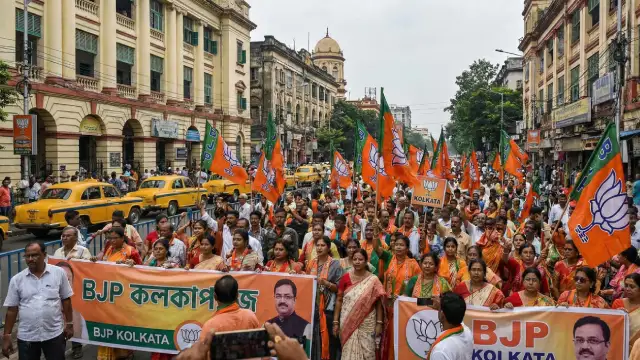
The 2026 assembly elections in West Bengal remain more than a year away, yet political parties have already begun their ground preparations in ways that raise serious concerns. Communalism has emerged as the dominant political theme, with religious antipathy becoming the centrepiece of electoral strategy.
The Election Commission of India has completed its Special Intensive Revision (SIR) of electoral rolls in West Bengal, and hearings have commenced, generating widespread anxiety. The Bharatiya Janata Party (BJP) claims Bengali Hindus have nothing to fear, yet most refugees in the state remain apprehensive. Though the West Bengal BJP has stoked communal rhetoric around the SIR, it has failed to allay the concerns of Hindu refugees.
The SIR process has been marketed as a mechanism to identify Bangladeshi and Rohingya infiltrators. BJP leader Suvendu Adhikari has repeatedly claimed that 15m people will be struck off the electoral rolls, alleging they are all Rohingya or Bangladeshi infiltrators. This assertion defies basic demographic reality. The global Rohingya population stands at approximately 1.4m, with roughly 900,000 sheltering in Bangladeshi refugee camps. Yet according to the BJP’s calculus, millions of Rohingya somehow roam India.
Behind this politics—or, as opponents argue, behind the current SIR exercise itself—lies the BJP’s strategy of spreading communal poison to divert public attention from substantive problems.
Though the SIR process occurs routinely every two decades, it has been weaponised as a political tool this time. Both the BJP and the Trinamool Congress (TMC) are exploiting it for partisan gain, generating fear while sections of the media disseminate messages of hatred. The BJP has established a template for spreading Islamophobia through a routine governmental procedure.
The BJP leadership recognises that 2026 will not offer the straightforward contest they faced in 2021. Consecutive defeats have weakened the party’s booth-level organisation. This has prompted fresh attempts at religious polarisation.
The saffron party has mobilised crowds from the cow belt to attend Gita recitation events at Kolkata’s Maidan, where Muslim street vendors have been attacked. Simultaneously, in Murshidabad, expelled TMC legislator Humayun Kabir has initiated efforts to establish a “Babri Masjid”. Chief Minister Mamata Bandopadhyay continues to inaugurate temples one after another, while the TMC leadership has instructed its members to visit religious sites during electoral campaigns.
These developments confirm that both the BJP and TMC seek to contest the 2026 elections on the basis of religious division.
Religious card after corruption failed
Following its 2021 defeat, the BJP attempted to corner the TMC through corruption charges. The Central Bureau of Investigation (CBI) and the Enforcement Directorate (ED) were deployed for this purpose, with raids conducted on various TMC leaders and ministers’ residences. Many were imprisoned in cases involving education scams, ration fraud and cattle smuggling. However, the situation changed after the BJP’s defeat in the 2024 Lok Sabha elections. CBI and ED raids diminished, and figures including Anubrata Mondal and Partha Chatterjee secured bail.
The state BJP leadership has acknowledged that defeating the TMC through corruption charges proves impossible in West Bengal. Despite rhetoric about transparent administration, their actual focus has re-shifted to religious division and Islamophobia. The nationwide anti-Bengali campaign assists this BJP strategy, which the TMC exploits to consolidate support amongst minority Muslims and the secular segment of the majority Hindu population.
Left parties oppose this polarisation, attempting to build public opinion around employment and inflation. The Communist Party of India (Marxist) [CPI(M)] is leading another Bangla Bachao Jatra (Save Bengal March) from north to south Bengal, mirroring its 2024 effort. However, political analysts believe the Left’s fortunes will not improve in 2026 either.
A fundamental question persists: why has communal politics spread in a state like West Bengal, where sectarian politics historically remained marginal in the post-independence period? Why has religious polarisation, hatred and violence intensified continuously since 2017? The Left, particularly the CPI(M), blames both sides but fails to examine the underlying economic causes. Understanding the rise and rapid spread of religious divisiveness requires grasping its economic foundations.
Economic basis of West Bengal’s communal politics
The rise of communal politics in West Bengal stems from artificially created economic conditions. Eight decades after partition, Indian Bengalis have failed to develop indigenous capital. Commerce has not expanded. Capital in the state remains concentrated in the hands of non-Bengali Marwari and Gujarati communities, with the business world remaining under their control.
Examining the boards of the state’s ten most successful start-ups reveals the situation. Only two include some Bengali representation, while the rest are entirely non-Bengali enterprises.
The working population of Bengali communities divides into four categories: agricultural workers, migrant labourers, permanent or temporary workers employed in the state, and government or private-sector salaried employees.
The agricultural crisis created since 2011 has rendered farming unprofitable. Irrigation problems in north Bengal and flooding in south Bengal have persisted for generations, but climate change has inflicted severe damage on rain-dependent and weather-dependent agriculture. Research by Bidhur Pariya, Pulak Mishra and Bhagirath Behera in 2022 documented this reality. Climate change has also profoundly affected coastal agriculture.
Consequently, farmers across various districts have shifted over two decades from rice or food grain cultivation towards crops requiring less water and cash crops.
West Bengal’s farmers’ average income ranks amongst the country’s lowest. They must seek earnings beyond agriculture, yet the Central Government continuously reduces expenditure under the Mahatma Gandhi National Rural Employment Guarantee Act (MGNREGA). The Union’s dues to the state remain unpaid for years. Most agricultural workers, therefore, leave their villages to become migrant labourers in other states.
The BJP government now effectively abolishes the MGNREGA through amendments to the law. Experts and opposition leaders believe rural employment opportunities will further diminish under the amended act.
The mass departure of migrant workers has created vacancies in agricultural work and general gig labour within West Bengal. Migrants from Bihar, Jharkhand and eastern Uttar Pradesh fill this void. Driven by this migration, the state’s demographic composition is changing.
Amongst permanent or temporary workers employed in the state, intensive labour jobs remain dominated by non-Bengali Hindi-speaking workers. Bengali-speaking workers constitute a negligible presence in jute mills and factories. This demographic transformation appears in both private and government employment.
Companies owned by Marwari and Gujarati capital in West Bengal are concentrated in Kolkata. These companies offer salaries substantially lower than those in Delhi, Maharashtra or Karnataka. Educated Bengali youth must therefore seek work in other states. Though this trend began in the 1980s, it has intensified over the past decade. Work exists in Bengal, but Bengalis cannot secure it. When they do, adequate remuneration proves elusive. Most skilled people have been forced to leave the state. Their departure further reduces West Bengal’s Bengali population, with many settling permanently in other states.
The 2027 census will reveal how much the Hindi-speaking population in West Bengal has increased compared with 2011.
The accounts of companies relocating from West Bengal reveal an even more alarming reality. According to government data provided in response to a Rajya Sabha question by Samik Bhattacharya, BJP MP and state secretary, on July 22nd 2025, answered by Harsh Malhotra, minister of state for corporate affairs, a total of 6,688 companies shifted their registered offices from West Bengal to other states between April 2011 and March 2025. More than one company departed daily on average.
The most striking aspect of this exodus remains the sharp acceleration beginning in the 2015-16 financial year. While 382 companies had relocated in 2014-15, the following year saw that number more than double to 869. This upward trajectory continued, reaching its peak in 2017-18 when 1,027 companies departed. In recent years, 371 and 366 companies relocated in 2023-24 and 2024-25, respectively. The process continues.
Three states emerged as principal beneficiaries. Maharashtra attracted 1,308 companies, representing nearly 20% of all relocations. Delhi came second with 1,297 companies. Uttar Pradesh—presumably Noida—secured third place with 879 companies. These three states together absorbed more than half of all companies that left West Bengal. Chhattisgarh received 511, Gujarat 423 and Rajasthan 333 companies.
The destination of listed companies proves particularly significant. Of the 6,688 companies that relocated, only 110 were listed entities, yet their importance far exceeds their numerical proportion. Maharashtra secured 45 of these listed companies, Delhi received 20 and Gujarat obtained 14. High-profile corporations with substantial operations gravitated overwhelmingly towards established industrial and commercial ecosystems in these three states.
Labour costs in Maharashtra or Delhi exceed those in West Bengal. However, the wage differential alone does not explain relocation. Problems have arisen from deteriorating law and order in West Bengal, excessive police demands for bribes on goods transport, extortion from businesses and various forms of pressure.
An even greater problem concerns West Bengal’s infrastructure. The TMC government has remained indifferent to comprehensive development. Though announcements of new industries arrive annually, the state has failed to build the deep-sea port essential for its economy.
These commercial problems, the absence of Bengali capital in the state, the TMC government’s lack of business-friendly policies, and pervasive anarchy and corruption have reduced prospects for new investment in West Bengal.
According to the Central Government’s data, West Bengal’s unemployment rate stood at 5.5% in the second quarter of the 2024-25 financial year, below the national average of 6.4% during the same period. Economic experts attribute this partly to mass departures in search of work and the influx of people from other states permanently settling in West Bengal to work for lower wages. This balance maintains a low unemployment rate despite the absence of employment opportunities in West Bengal.
However, this does not indicate that the rest of India’s overall economic situation remains healthy.
Economy of despair drives India’s communal politics
Communal politics intensifies during crises in capitalist economic systems. Precisely when unemployment rises, income opportunities contract, crime increases and corruption runs rampant, religious hatred becomes rapidly exploited for political purposes.
India’s complete economic picture points towards a deeply discouraging chapter.
Government data on private company closures over the past five years presents an alarming picture of the country’s industrial and commercial situation. According to information provided by Harsh Malhotra, minister of state for Corporate Affairs, in response to a Lok Sabha question by Ramashankar Vidharthi Rajbhar on December 1st 2025, a total of 204,268 private companies closed between the 2020-21 and 2024-25 financial years through amalgamation, conversion, dissolution and strike-off.
The most notable and surprising aspect of these statistics concerns the pattern of company closures during the COVID-19 pandemic. Conventional wisdom suggested that 2020 and 2021, when India faced an acute COVID-19 crisis, should have witnessed maximum closures. Reality proved entirely different. Only 15,216 companies closed in 2020-21, the lowest figure in this five-year period. Instead, company closures surged dramatically in subsequent years after the pandemic’s direct impact receded.
Closures in 2021-22 rose to 64,054, more than four times the previous year. This upward trend continued, reaching a peak of 83,452 closures in 2022-23, the highest single-year figure across five years. Numbers subsequently declined to 21,181 and 20,365 in 2023-24 and 2024-25, respectively, though these figures remain significantly higher than pre-pandemic levels.
The government’s indifference towards rehabilitating employees affected by these massive closures proves particularly troubling. In response to the parliamentary question, the government stated explicitly that no special scheme or plan exists for employee rehabilitation. More than 200,000 company closures mean thousands of employees have lost their livelihoods, yet no specific measures have been adopted for their social and economic security.
Furthermore, the government’s policy position on providing tax exemptions or incentives for establishing industries in backward and rural areas makes clear that simplifying the tax structure takes precedence over reducing regional disparities. These statistics and policy responses together raise profound questions about the country’s industrial and commercial health and employment situation, particularly during the post-pandemic recovery phase.
This employment crisis has consistently provided the BJP with muscle power in exchange for money. That application currently operates in West Bengal through various means.
Areas where non-Bengali migrant workers connect directly with the rise of Hindutva forces and violent incidents stretch from Asansol in West Bardhaman district to Rishra in Hooghly or Shibpur in Howrah. These clashes have primarily occurred between Hindi-speaking Hindus and Bihari Muslims.
The continuing departure of Bengali workers and the middle class from the state in search of work, with the resulting vacuum filled by continuous immigration from the cow belt, has influenced the state’s politics. Communal politics from the cow belt has entered West Bengal, taking deep root amongst Bengali Dalits and backward communities.
Migration, political polarisation in West Bengal
Migration to West Bengal from Bihar, Jharkhand and eastern Uttar Pradesh has occurred since British colonial rule. Bengali nationalist organisations like Bangla Paksha allege that this migration rate has increased tremendously over the past 15-20 years.
Initially, the TMC benefited politically from this migration. The TMC vote bank remains strong in various Hindi-speaking belts. However, the BJP has gained politically from increased migration since 2016-17.
The continuous ageing, death and departure of hardcore Left voters, particularly CPI(M) supporters, combined with their descendants either tilting towards the saffron camp in opposition to the TMC or leaving the state, explains this shift. As the Left’s vote bank has eroded, the TMC vote bank has strengthened on one side, while the BJP has also increased its strength by relying on outside voters.
Consequently, these two forces in state politics currently court Hindi-speaking migrants who are gradually becoming the majority in various districts. This increases the likelihood of greater religious polarisation in future.
This ongoing Hindi infiltration has not merely strengthened Hindutva parties politically. It has also culturally intensified North Indian aggression. The BJP will benefit from this aggression, its critics and Bengali nationalists believe. The TMC, understanding the ground reality, will also continue attempting to expand its vote bank by maintaining an appeasement policy towards these migrants.
This will not just marginalise the Bengali and other indigenous people, the sons of the soil, but this could severely impact Left parties like the CPI and CPI(M). Those who organised farmers’ and workers’ movements in West Bengal now face a crisis.
Examples have emerged in Hooghly’s jute mill areas or Howrah’s declining industrial zones. Religious polarisation has intensified there. Left trade union leaders complain that the BJP has succeeded in spreading communal politics among working people.
In many jute mills in these areas, workers remain with the red flag during union struggles yet vote for the TMC or the BJP in elections. They do not vote for the CPI(M) or other Left parties. Though the CPI(M) leadership cites a lack of political consciousness, regional political influence actually operates behind this phenomenon.
Workers arriving from the cow belt have consistently exploited the gap between labour demand and supply created by Bengali workers’ reluctance to engage in intensive labour. During the Left rule, these Hindi-speaking workers benefited from remaining with red flag unions because of governmental power. That opportunity no longer exists under TMC rule. Workers in jute mills and some other industries have observed that forces besides the Left, despite practising communal politics, stay away from movements for wage increases or just demands. Therefore, a section of these migrant workers, particularly in jute mills and coal mining areas, remains with the Left for protecting their rights inside factories. However, outside the factory, in their personal political circles, most of this section aligns with the TMC or the BJP because of religious identity.
What path remains open for the Left?
Can the Left recover? This question intensified after the 2019 Lok Sabha elections, when Left parties failed for the first time since independence to send a single MP from West Bengal to parliament. Following the rout in the 2021 assembly elections, questions arose about the Left’s future. The 2024 Lok Sabha elections saw a repetition.
In these circumstances, two paths remain open for the Left to re-establish itself politically. First, they must acknowledge the ground reality of state politics and attract non-Bengali voters, particularly working people and gig workers. A large section of these workers has arrived from Bihar, Jharkhand or eastern Uttar Pradesh. The BJP’s influence from their home states naturally exceeds that of West Bengal’s Left parties amongst them. Drawing them to the Left, particularly for the CPI or CPI(M), proves extremely difficult.
Second, they must fight on the issue that this migration is turning West Bengal into a settler colony and artificially keeping minimum wages low in the state, alongside some popular demands.
Since the first path proves extremely difficult for the Left, the second path will remain open to them. Successfully pursuing that path could help liberate Bengali nationalism from parochialism and place it in a broader context.
The current Bangla Bachao Jatra shows no indication that the CPI(M) wishes to change its strategy and methods. Signs of making itself relevant again in the state’s electoral politics remain absent. If the Left cannot accomplish this task before elections, 2026 may prove a repetition of 2019, 2021 or 2024. As a result, the state may continue to reel under competitive communal politics, increasing the risks for major conflagrations.

Unsigned articles of People's Review are fruit of the collective wisdom of their writers and the editors; these articles provide ultimate insight into politics, economy, society and world affairs. The editorial freedom enjoyed by the unsigned articles are unmatchable. For any assistance, send an email to [email protected]