
Hindutva forces attack Jadavpur University as ‘dimagi Naxal’ hunt comes home
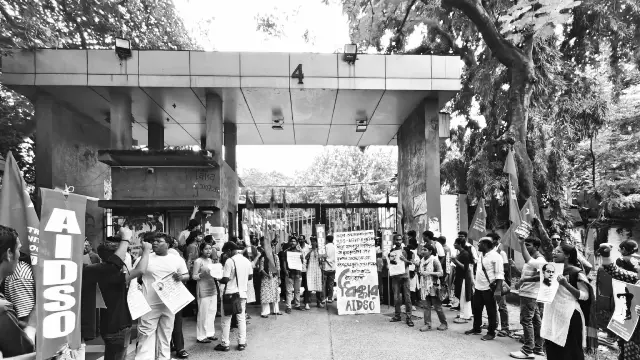
Five days after Narendra Modi stood at the Red Fort and warned of “dimagi Naxals” — Naxalites of the mind — Hindutva forces attacked Jadavpur University in Kolkata. What began as a scuffle over a students’ union meeting on Wednesday night spilt into Thursday afternoon, when Akhil Bharatiya Vidyarthi Parishad (ABVP) supporters tore down police barricades at the campus gates and pelted eggs, water bottles and lathis at the Left students squatting behind them. West Bengal‘s three-month-old Bharatiya Janata Party (BJP) government, students say, had found its target.
The trouble began at a general body meeting of the Faculty of Engineering and Technology Students’ Union on Wednesday evening. The ABVP says one of its own, Nikhil Das, was assaulted there by members of the Students Federation of India (SFI) and organisations like the Democratic Students’ Organisation (DSO) and Democratic Students’ Federation (DSF); the Left says outsiders brought in by the ABVP started the violence. The SFI claimed its members were not present in the meeting.
What is not disputed is what came after.
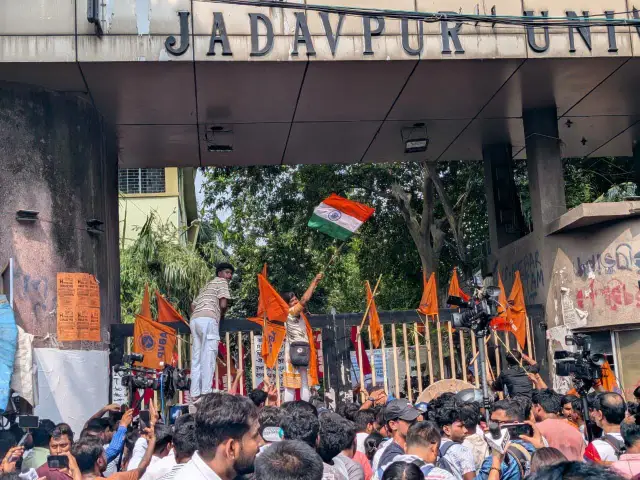
A video circulating that night showed a mob armed with lathis and swords breaking open the campus gate and heading for Aurobindo Bhawan, where Left-leaning students were gathered. Fires were set, Left flags burnt, and the iron frame around Nandalal Bose’s emblem of the university was ripped off and hurled back over a locked gate the next afternoon.
Hindutva forces return to familiar campus
By Thursday afternoon, ABVP supporters marching from Gol Park had reached Gate 4, breaking down the barricades Kolkata police had built near Jadavpur police station. One functionary, Shubhabrata Adhikari, told reporters the party would keep coming, day or night, and that the campaign had nothing to do with the BJP — a disclaimer undercut, the same day, by West Bengal’s urban development minister, Agnimitra Paul, who wished the injured ABVP activists a swift recovery and vowed on social media that the ideological battle against “dimagi Naxals” would continue. Outside the locked gates, Communist Party of India (Marxist) [CPI(M)] leader Dipsita Dhar and SFI state secretary Debanjan Dey accused the ABVP of trying to torch the university the night before and demanded charges under the anti-Goonda Act. Police eventually filed one FIR, naming 11 people.
Jadavpur is only the latest target. For over a decade the BJP and its parent body, the Rashtriya Swayamsevak Sangh (RSS), have hounded India’s public universities — Jadavpur, Jawaharlal Nehru University, Jamia Millia Islamia, the University of Hyderabad, the Tata Institute of Social Sciences, Aligarh Muslim University — on the pretext of a “left-Islamist” conspiracy, each round of vilification a licence for the next crackdown.
University as proxy for larger fight
The pretext has grown thinner because the target has grown larger. Students from these very campuses backed the protests that erupted at Delhi’s Jantar Mantar after leaked question papers derailed national entrance exams, protests that eventually forced Dharmendra Pradhan to resign as education minister. Rahul Gandhi and other opposition leaders say the government now faces something it has never had to fight before. It’s not a minority it can other, as it did Muslims during the citizenship protests or Sikh and Jat farmers in 2020-21 farm protests, but an entire generation.
Most of these students are not the usual suspects. Many come from upper-caste Hindu homes; some, like the All-India Students’ Association (AISA) leader Neha Bora, from families of committed BJP voters. The police response to the July 20th march on Parliament — force turned on peaceful marchers — only widened the circle, sending the protests to Mumbai, Bengaluru, Kolkata and beyond. When Hindu youths in Bihar and Uttar Pradesh, the BJP’s own base, began joining in, the party had a problem no polarisation could solve. Now it needed to hold its own voters together, not just divide everyone else’s.
Instagram reels of the prime minister followed, then advertisements testifying to the youth’s love for the government. Both were met with mockery from a generation that does not watch television and does not much believe what it is told. Modi, the opposition says, ran out of charm and reached for a label instead: dimagi Naxal — the same phrase, within days, on a Bengal cabinet minister’s timeline.
Jadavpur has form. In 2019 its students trapped Babul Supriyo, then one of Modi’s own ministers, inside a hall for hours; in March 2025 they penned in Bratya Basu, the state’s education minister at the time, demanding student-union elections that have not been held since 2020. What is new is not the campus’s appetite for confrontation. It is a state government answering that appetite with the same phrase the prime minister used from the ramparts of the Red Fort. The vice-chancellor, Chiranjib Bhattacharjee, promised an inquiry and a night-time ban on outsiders; he did not explain why students’ union elections that might settle these disputes at the ballot box still have not been called.
Speaking in Kolkata on August 15th, Dipankar Bhattacharya, general secretary of the CPI(M-L) Liberation, put the target in context. Even Jyoti Basu, West Bengal’s former Marxist chief minister, he said, could be called a Naxal by Modi’s yardstick. He spoke, pointedly, in Jadavpur’s own neighbourhood — a constituency with almost no students in it, and one that voted BJP in the last assembly election.
He wasn’t alone. CPI(M) state secretary Mohammad Salim, along with leaders from other Left Front constituencies, also raised their concerns over Modi’s alleged witchhunt drive.
The Left Front’s meeting saw a large-scale assembly of common people, which SFI and AISA leaders on the campus cite as one of the reasons behind the Hindutva forces launching an attack on Jadavpur University. However, they believe the juggernaut won’t stop there.
Why Jadavpur won’t be the last
From CPI(M-L) Liberation’s Bhattacharya, AISA and SFI, and every other left faction, allege that “dimagi Naxal” is not a diagnosis but a licence. It lets the government treat a maths student in Lucknow, a farmer’s son in Muzaffarpur, an engineering fresher in Jadavpur and a retired communist grandee as members of one conspiracy — supposedly run out of the deep state, financed by George Soros, and staffed on rotation by Pakistan, China and the United States.
To terrify the “dimagi Naxal” forces, the Modi government is likely to attack students present on other campuses as well. The litmus test of Jadavpur University, which the left students’ unions call their bastion, will help the far-right forces under the ABVP to improvise their attacking skills.
Meanwhile, the BJP government in West Bengal has shown a biased attitude, students allege. Yet, the state BJP chief Samik Bhattacharya, using his signature husky voice, claimed that the party has no ties with the ABVP and doesn’t believe in students’ politics.
The charge sheet does not need to make sense to do its job. Soros and Beijing are not allies; Washington and Islamabad have contrasting relations with Beijing, and the CIA is not China’s pet. A protest movement genuinely run by all four at once would be the most improbable joint venture in espionage history. But coherence was never the point. The point is to make dissent illegible — to turn a farmer’s son, a chief minister’s ghost and a BJP voter’s daughter into a single, disposable enemy, so that beating down one does the work of silencing them all.
The frame around Nandalal Bose’s emblem still lies wherever it landed when it was thrown back over the gate. Jadavpur’s students paid for that logic on Wednesday night, and again on Thursday afternoon. They will not be the last.

Unsigned articles of People's Review are fruit of the collective wisdom of their writers and the editors; these articles provide ultimate insight into politics, economy, society and world affairs. The editorial freedom enjoyed by the unsigned articles are unmatchable. For any assistance, send an email to [email protected]