
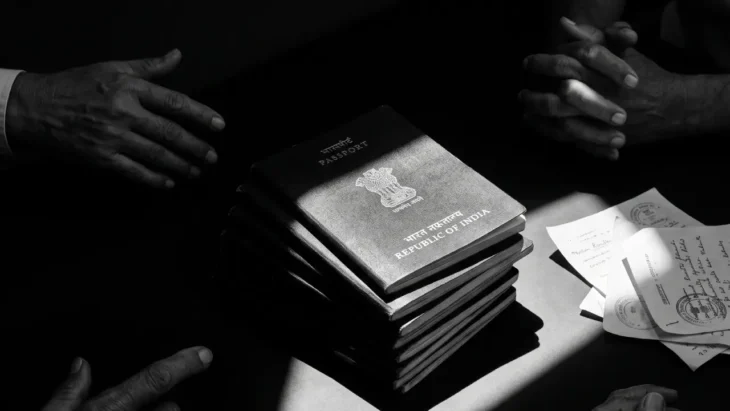
Indian passport isn’t citizenship proof — this debate predates Modi
The Indian government’s recent assertion that a passport is not, by itself, proof of citizenship has sparked intense political debate. Opposition parties, including the Congress party, the pro-Mamata Bandopadhyay Trinamool Congress (TMC) and others have accused the government of deepening uncertainty over Indian citizenship, particularly at a time when the Election Commission is conducting the Special Intensive Revision (SIR) of electoral rolls in several parts of the country. They argue that the statement risks creating confusion and anxiety among millions of voters over the documents required to establish their citizenship.
The federally ruling Bharatiya Janata Party (BJP), however, has strongly defended the government’s position. Party leaders have repeatedly argued that treating a passport as anything other than conclusive proof of citizenship is not a policy introduced during Prime Minister Narendra Modi‘s tenure but rather a long-standing legal position that predates the BJP government.
Given the widespread anxiety generated by the SIR process, police action against Bengali-speaking people across India in the name of identifying and “pushing back” alleged “Bangladeshi infiltrators”, and the continuing controversy surrounding the proposed National Register of Citizens (NRC), opposition parties are unlikely to dispel public suspicion about the government’s intentions. For many, especially among Bengali-speaking communities, these developments appear interconnected.
Yet the Ministry of External Affairs’ (MEA) recently publicised position on the passport is not, in itself, a new decision taken by the Modi government. The legal basis for this position has existed for decades.
This question first gained widespread public attention during the nationwide protests against the Citizenship (Amendment) Act, 2019 (CAA 2019) and the proposed NRC. While the protests primarily challenged the CAA and NRC, they also exposed a deeper constitutional question: what legally constitutes proof of Indian citizenship?
In West Bengal, citizenship rights campaigners played a particularly important role in bringing this debate into the public sphere. The anti-NRC movement itself became divided over which documents could legitimately establish Indian citizenship, with activists, lawyers and scholars advancing competing interpretations of the Citizenship Act, 1955, and related legal provisions.
Successive interpretations of the Citizenship Act, 1955, together with subsequent amendments and judicial observations, have consistently suggested that no single document held by an individual conclusively establishes Indian citizenship. This legal position also explains why the Election Commission’s ongoing SIR exercise requires voters to produce multiple categories of supporting documents rather than relying upon a single identity document.
Why an Indian passport is not citizenship proof
Obtaining an Indian passport is neither simple nor automatic. Applicants are required to submit multiple documents to establish their identity and residential address, and the authorities also conduct police verification to determine whether any criminal cases are pending against the applicant.
For decades, people have considered the passport as a genuine document of Indian citizenship, without understanding the underlying conditions.
Internationally, an Indian passport serves as documentary evidence that its holder is travelling under the protection of the Republic of India. Foreign governments ordinarily recognise the holder as an Indian national for the purposes of international travel and consular protection. Within India, however, the legal position is different.
A passport does not, by itself, constitute conclusive proof of citizenship under Indian law. This is because the passport is issued under the Passports Act as a travel document rather than as a certificate of citizenship. Even under the current Passport Act, 1967, section 20 permits a non-citizen to be issued an Indian passport in extraordinary circumstances.
Moreover, Indian authorities have acknowledged that in certain circumstances, even individuals later found to lack valid Indian citizenship may have obtained passports through legal or fraudulent means. Consequently, the MEA maintains that a passport is primarily a travel document and not definitive proof of Indian citizenship.
Indian courts have repeatedly reinforced this distinction.
In 2013, Justice KU Chandiwal of the Bombay High Court held that a passport could not, on its own, be treated as conclusive evidence of Indian citizenship within the country. Earlier, the Supreme Court had accepted that a passport could serve as evidence of nationality in particular legal contexts, but only when read alongside other legally recognised documents, including birth records and other statutory evidence required under citizenship law.
The principle was reaffirmed in 2015 in Babul Islam vs State of Assam, when the Guwahati High Court ruled that documents such as voter identity cards and Permanent Account Number (PAN) cards do not, by themselves, establish Indian citizenship. Given longstanding concerns about forged official documents and fraudulent identity papers, Indian courts have consistently refused to recognise passports or other identity documents as standalone proof of citizenship.
The burden of proving citizenship became even more significant following the Supreme Court‘s judgment in Sarbananda Sonowal vs Union of India (2005). Unlike criminal law, where an accused person is presumed innocent until proven guilty, citizenship proceedings effectively place the burden upon the individual to establish that they are an Indian citizen. Until that burden is discharged, the individual may be treated as having failed to prove their citizenship.
What constitutes citizenship proof under Indian law?
To understand why an Indian passport is not regarded as conclusive proof of citizenship, it is necessary to examine the evolution of India’s citizenship laws.
The two most significant changes to the Citizenship Act, 1955, were brought about by amendments enacted in 1986 and 2003. Together, these fundamentally altered how Indian citizenship is determined and laid the legal foundation for the NRC.
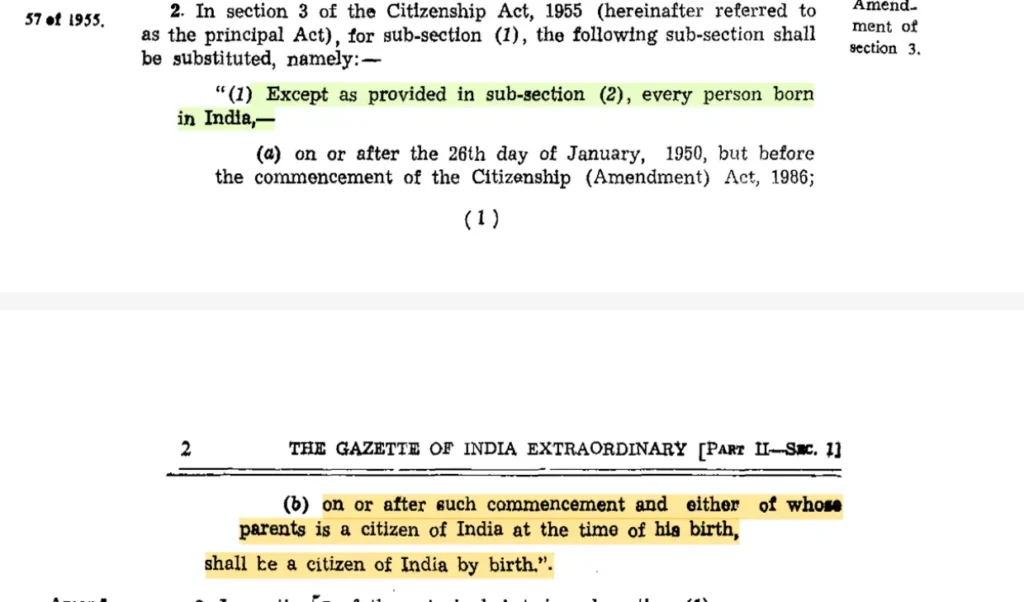
The first major change came with the CAA in 1986, which came into force on July 1st 1987 and is hence known as CAA 1987. Before this amendment, virtually every person born in India after the Constitution came into effect on January 26th 1950, was entitled to citizenship by birth. The 1986 amendment ended this principle of unconditional birthright citizenship.
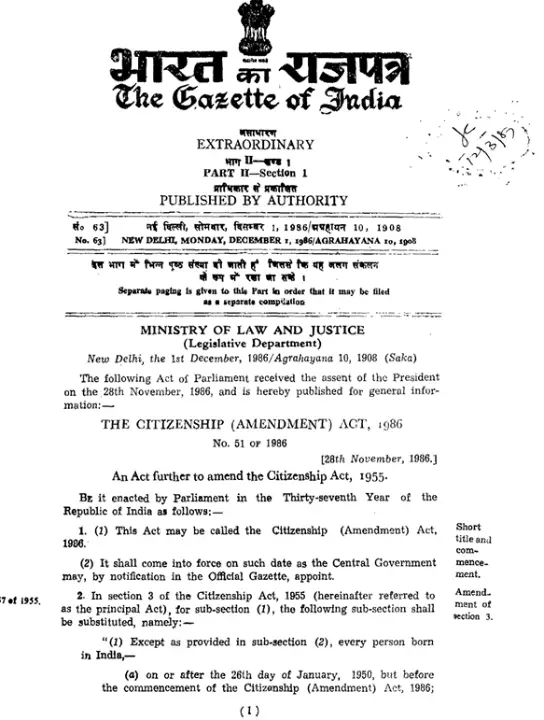
Under the amended law, individuals born between January 26th 1950 and July 1st 1987, continued to qualify as Indian citizens by birth, provided they could establish the relevant facts through legally recognised documents such as birth certificates and other contemporaneous records. For those born after July 1st 1987, however, citizenship by birth became conditional. At least one parent had to be an Indian citizen, and that status itself had to be established through documentary evidence.
The origins of this legislative shift lie in the political developments that followed the Assam Movement. Emerging from the earlier anti-Bengali mobilisation in Assam, the movement culminated in the Assam Accord between the Union government and the All Assam Students’ Union (AASU). One of its principal objectives was to identify Bengali refugees and migrants who had entered Assam from Bangladesh, remove their names from the electoral rolls and facilitate their deportation.
It was during this period that the political narrative of the “illegal immigrant” moved from being a regional issue in Assam to becoming a national political question. By the 1990s, this discourse had been adopted by India’s broader political establishment, particularly by Hindutva organisations, one of whose principal political representatives would later become the BJP under Modi.
Yet the most consequential transformation came at the beginning of the twenty-first century.
In December 2003, the National Democratic Alliance (NDA) government led by former prime minister Atal Bihari Vajpayee secured the passage of the CAA 2003 through both Houses of Parliament. Unlike the CAA 2019, which triggered nationwide protests, the 2003 amendment attracted little public opposition. The Rajya Sabha’s Department-related 107th Parliamentary Standing Committee supported the legislation by consensus, and the Bill passed without generating significant national debate.
The legal architecture created by the 2003 amendment would later prove even more consequential than the 2019 legislation. From the perspective of many citizenship rights campaigners, particularly in West Bengal, the 2003 amendment established a framework that could lead to large sections of India’s undocumented and document-deficient population facing challenges in proving their citizenship.
The implementation of this framework did not stop with the NDA government. In December 2004, the United Progressive Alliance (UPA) government, led by the Congress party, operationalised the legal provisions enacted the previous year. These rules, introduced with the support of Left parties then backing the UPA government from outside Parliament, created the administrative mechanisms required to implement the amended citizenship regime.
It was the CAA 2003 and the rules framed under it—not the CAA 2019—that introduced the legal basis for preparing a nationwide NRC. Under this framework, the NRC would eventually become the definitive register of Indian citizenship after its completion.
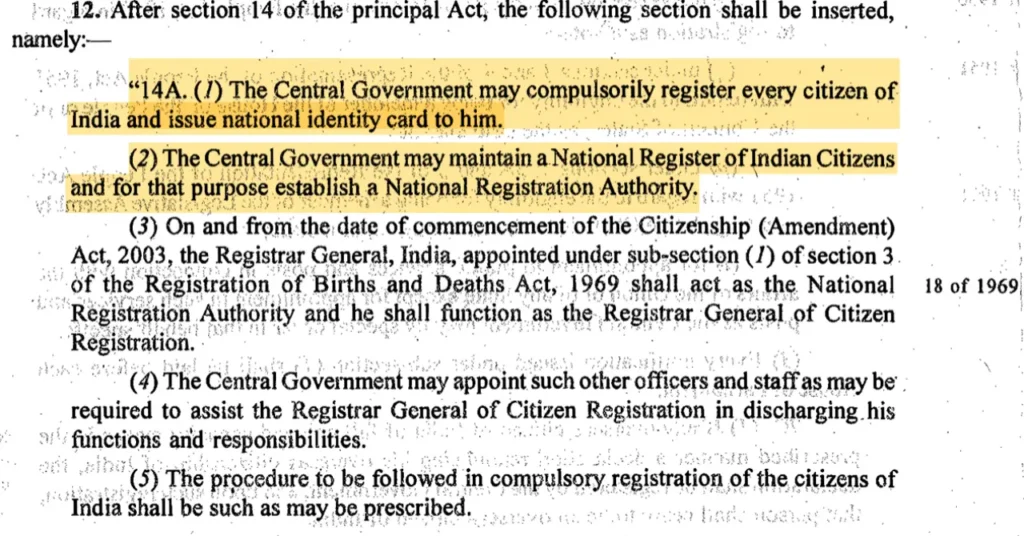
In other words, under the legal framework established by the 2003 amendment, the NRC is intended to serve as the authoritative record of Indian citizenship. Until such a register is prepared, no single document—including an Indian passport, voter identity card, or PAN card—can by itself serve as conclusive proof of citizenship under the existing legal interpretation.
From NPR to NRC
The legal framework established by the CAA 2003 envisaged that the preparation of a nationwide NRC would be preceded by the creation of a comprehensive National Population Register (NPR). While public attention has largely focused on the NRC, the NPR constitutes the administrative foundation upon which such a register would eventually be built.
Work on the NPR gathered pace during the tenure of the UPA II government. Around 2010, the Union government began compiling demographic data through the NPR while simultaneously introducing the Aadhaar programme, creating what would become India’s largest digital identity database.
The Modi-led NDA subsequently expanded this architecture by linking Aadhaar with an increasing number of government records, welfare schemes and identity documents. Over time, Aadhaar evolved from a voluntary identity programme into the principal digital identifier used across much of the Indian state’s administrative machinery.
Against this backdrop, critics argue that the ongoing SIR of electoral rolls represents more than a routine exercise to update voter lists. They contend that the information now being collected—including details relating to an individual’s place of birth, family relationships and electoral records—could complement the extensive database already assembled through Aadhaar and other government repositories.
In states such as West Bengal, where concerns over citizenship have intensified in recent years, campaigners believe that the SIR process may enable the Union government to consolidate information that could subsequently be used during future NPR or NRC exercises. Whether or not this is the stated objective of the authorities, the overlap between different identity databases has become a source of growing public anxiety.
The significance of these concerns lies in the cumulative nature of India’s evolving citizenship regime. Rather than relying on a single document, the administrative framework increasingly relies on the cross-verification of multiple records collected over several decades. Birth records, family details, electoral rolls, Aadhaar-linked databases and population registers may all be examined together when questions of citizenship arise.
Supporters of the government’s approach argue that such integration is necessary to improve the accuracy of public records, eliminate duplication and strengthen the integrity of electoral rolls. Critics, however, warn that inconsistencies across different databases—many of which were created under different legal and administrative standards—could expose millions of legitimate residents to prolonged bureaucratic scrutiny.
Expressing his frustration over the MEA’s comment on the passport’s status as a travel document and not a citizenship proof, the Congress party’s Member of Parliament Shashi Tharoor wrote on X (formerly Twitter), “For decades, the passport has been considered the gold standard of identity. We navigate the gruelling bureaucratic maze of police verifications and document checks required to obtain one, precisely because the state demands concrete proof of citizenship before granting it. To turn around and declare that the very document born from this rigorous vetting does not actually prove citizenship creates an absurd legal paradox. If a passport does not establish domestic citizenship, then what does?”
These concerns are particularly acute in West Bengal. Citizenship rights activists argue that documentation gaps, clerical errors, inconsistencies in spelling, migration within India and the absence of historical records disproportionately affect Bengali-speaking communities and other socially and economically marginalised groups. They fear that administrative discrepancies, rather than questions of legal status, may ultimately determine whether individuals are required to prove their citizenship.
Viewed in this context, the MEA’s recent clarification that an Indian passport does not constitute proof of citizenship appears less like an isolated policy announcement than as one element in a much longer evolution of India’s citizenship framework. The legal distinction between identity documents and citizenship has existed for years, but it has taken on greater political significance as successive governments expand the administrative mechanisms through which citizenship may eventually be verified.
Controversy rooted in older legislation
Seen in this broader legal and political context, the MEA’s insistence that an Indian passport is not citizenship proof is not a policy innovation introduced by the Modi government. Rather, it reflects the legal consequences of a citizenship framework that has evolved over more than two decades and has been shaped by governments of different political persuasions.
From this perspective, the controversy extends beyond the BJP. While the Modi government has accelerated the integration of identity databases and introduced measures such as the CAA 2019, the legal architecture underpinning the present citizenship regime was created through the CAA 2003 and the rules subsequently framed under successive governments.
The CAA 2003, passed by the Vajpayee-led NDA, in which Bandopadhyay’s TMC was a constituent, with the Opposition, including the Congress, the Left and others giving consent, had turned millions of Indians, especially the marginalised people, “doubtful” entities in their homeland, making them suspects in the eyes of the state machinery.
The distinction between an identity document and citizenship proof therefore predates the current administration.
Citizenship rights campaigners argue that this historical continuity is often overlooked in contemporary political debate. Public criticism has largely focused on the BJP and the Modi government, while comparatively little attention has been paid to the bipartisan legislative process through which the present framework emerged. In their view, governments led by both the NDA and the UPA, with the support or acquiescence of other mainstream political parties, contributed to the legal regime that now governs the verification of citizenship.
Against this backdrop, concerns surrounding the SIR extend beyond the immediate question of electoral rolls. Social and political activists in West Bengal argue that the exercise has already resulted in widespread hardship, with millions of voters reportedly facing difficulties because of documentary discrepancies and so-called “logical discrepancies” in official records. They fear that similar administrative challenges could become more extensive if a nationwide NPR, which is conducted along with the population census, is followed by a comprehensive NRC creation.
Such concerns are especially pronounced among Bengali-speaking communities, many of whom view successive citizenship initiatives through the lens of earlier political campaigns targeting alleged illegal immigration from Bangladesh. Campaigners in West Bengal argue that documentation deficiencies, inconsistencies in official records and the burden of proving citizenship could disproportionately affect communities with complex migration histories or incomplete archival records, regardless of their legal status.
At the same time, the legal position adopted by the government remains unlikely to change in the foreseeable future. Until a nationwide NRC is prepared under the existing citizenship framework, the authorities are unlikely to recognise an Indian passport as conclusive citizenship proof. The long-standing concern that official identity documents may have been obtained through forged or fraudulent records has consistently informed judicial reasoning and administrative practice.
Addressing this issue, Tharoor suggests, “To end this fatuous controversy once and for all, a common-sense legislative overhaul is urgently required. The government should formally amend the legal framework to make both the passport and the Aadhaar card valid, conclusive proofs of Indian citizenship unless they are explicitly cancelled or withdrawn by the state.”
“This dual-document policy would immediately streamline domestic verification, eliminate arbitrary bureaucratic challenges during electoral revisions, and provide every Indian with absolute, unquestionable legal certainty regarding their identity,” the MP added.
The recent statement by the Ministry of External Affairs (MEA) – – on #PassportSevaDivas, no less! – – clarifying that an Indian passport is primarily a "travel document and not conclusive proof of citizenship" has triggered a predictable wave of public bewilderment and…
— Shashi Tharoor (@ShashiTharoor) June 26, 2026
The present controversy, therefore, is not merely about whether a passport proves citizenship. It reflects a deeper debate over how citizenship itself is defined, documented and verified under Indian law. As the SIR exercise continues and discussions surrounding the NPR and NRC persist, the political argument is likely to remain focused on the actions of the Modi government. Yet the legal foundations of the current citizenship regime were laid over several decades through legislation enacted and implemented by successive governments across the political spectrum.
Whether future debates acknowledge that longer legislative history may shape not only the politics of citizenship but also public understanding of how citizenship proof is determined under Indian law.

An avid reader and a merciless political analyst. When not writing then either reading something, debating something or sipping espresso with a dash of cream. Street photographer. Tweets as @la_muckraker