
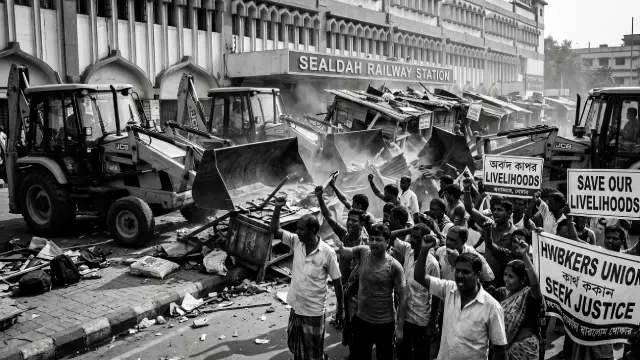
Evicting hawkers or cleansing cities for ‘Corporate India’?
The so-called “anti-encroachment” hawker eviction drive being carried out across railway stations in West Bengal — from Howrah and Sealdah to numerous other station areas — is being projected by the newly elected Bharatiya Janata Party (BJP) government in the state as an effort to “recover public land in the public interest”. The eviction and demolition drive carried out by the Indian Railways has been targeting hawkers and street vendors who sell food items or other commodities on railway premises across the state.
Much like Uttar Pradesh, the bulldozer has now become the cherished political vehicle of the BJP in West Bengal as well. And that bulldozer is now being unleashed upon poor people, irrespective of religion or caste. Shops built on land controlled by the Union government’s Railway Ministry are being demolished across the state, while pavements and station premises are being cleared out.
BJP supporters argue that “the law is equal for everyone”, that “encroachment cannot be allowed”, and that “railway stations must be cleaned up”. They say that those expressing sympathy for hawkers should accommodate the displaced vendors on the rooftops of their own homes. But the reality is that working people regularly rely on areas around railway stations and bus stands to urgently buy daily necessities, have tea, eat inexpensive food, or even shop for essentials. Needless to say, they are not going to climb onto the rooftops of privately owned homes to do so. Yet among BJP supporters and cadres, who seem eager to position themselves against poor and working people at every turn, no argument rooted in social reality ever seems to carry weight.
But the real question is: against whom is this eviction drive being conducted? And for whom is this “clean-up” operation intended?
The hawker being evicted today is not a multinational corporation. He is not a defaulter who owes thousands of crores to banks. He has not occupied airports, ports, or mines. He is a small vendor — someone who sells tea, fruits, clothes, and inexpensive daily necessities to ordinary people. His stall is not merely a shop; it is a family’s plate of rice, a child’s school fees, and medicine for ageing parents.
In a country like India, where the working-age population exceeds 550m, Gautam Adani’s Adani Enterprises — often accused of enjoying political proximity to the BJP — directly employs only around 36,000 people, while Mukesh Ambani’s Reliance Industries Limited employs roughly 389,000. Together, these two corporate giants directly employ less than 0.1% of India’s working population. Yet the Narendra Modi government at the Union has continued to provide such corporate groups with massive tax concessions, loan write-offs, land transfers, and the privatisation of public assets.
And the direct burden of these policies has fallen upon the public exchequer, funded by taxpayers.
Between the 2015-16 and 2024-25 financial years, nearly Rs 16.35 trillion worth of bank “bad loans” were written off. The overwhelming majority of these write-offs were carried out by India’s state-owned banks. Only about 13%-18% of the money these public-sector banks lent to corporations was ever recovered. In other words, for every Rs 100 borrowed, corporations returned only Rs 13-18 to public sector banks.
The money behind these written-off loans ultimately comes from public savings deposited in banks. And in many cases, these loans are not even used for productive expansion but for speculative activities such as purchasing shares in the stock market — including their own companies’ shares. In effect, corporations are gambling with public money.
It was in this context that investigations by the now-defunct American firm Hindenburg Research alleged that the Adani Group artificially inflated its share prices and then used those inflated shares as collateral to secure loans from India’s public-sector banks.
Hindenburg further alleged that India’s securities regulator — the Securities and Exchange Board of India (SEBI) — behaved in a biased manner in favour of Adani Enterprises.
Yet the BJP, which now claims to be deeply concerned about public property, government land, and public order in West Bengal, firmly stood by Adani Enterprises. The Modi government took no action against Adani or his business empire. Opposition parties repeatedly accused the Modi government of colluding with the Adani Group, yet no official action was taken against Adani or his companies.
Whenever allegations emerge against the Adanis or Ambanis, the BJP insists that “businesses must be protected”. The Modi government portrays them as investors and job creators, shielding them from scrutiny and swiftly dismissing allegations against them. But when a hawker sets up a stall beside a railway station, the state suddenly rediscovers the “rule of law”. Then it claims that illegal business activity is taking place.
It is precisely here that the class character of BJP politics becomes unmistakably clear.
On the one hand, airports, mines, ports, forests, and loans from public-sector banks are opened up to corporate capital. On the other hand, small traders, hawkers, rickshaw pullers, and pavement vendors are branded “illegal” and pushed out of cities. In the name of making cities “smart”, the poor are being erased from urban space itself.
It would be a mistake to view this eviction drive in isolation.
A decade ago, demonetisation delivered a severe blow to India’s largest source of employment — the MSME sector comprising micro, small, and medium enterprises. Countless cash-based small businesses collapsed, and millions lost their jobs, yet no serious government assessment was ever conducted of the scale of the destruction. Instead, the BJP transformed demonetisation into a political spectacle by claiming victory over black money. Later, it emerged that almost all the currency had returned to the banking system. But millions of ordinary people were devastated by this disastrous experiment.
Similarly, the introduction of the Goods and Services Tax (GST) by the Modi government locked up the working capital of small businesses. Corporate retail chains and e-commerce platforms steadily captured markets once occupied by small shopkeepers. During the COVID-19 lockdowns, small businesses suffered even deeper losses. While sections of the middle class migrated towards quick-commerce and e-commerce platforms, pavement markets remained one of the few affordable sources of goods and services for the poor. Now, even hawkers are being removed from railway stations and pavements. The worst affected will once again be marginalised people with extremely limited purchasing power. In other words, India’s informal economy continues to face sustained assault.
Hawkers are not a “problem” within India’s urban economy; they are one of its essential pillars. In Kolkata alone, the lives of millions depend directly or indirectly upon hundreds of thousands of hawkers. They provide inexpensive goods to workers and lower-middle-class families. Their eviction is not merely the demolition of a few stalls; it is an attack on local markets, small-scale economic networks, and the purchasing power of ordinary people.
Today, the BJP claims to oppose “encroachment”. Yet the very same state acquires thousands of acres of land for corporations, writes off loans taken from public-sector banks, and hands over natural resources — from Hasdeo Arand to the Aravalli hills — into private hands. Where does “public interest” disappear then?
The biggest question, therefore, remains: is destroying the livelihoods of the poor really the only way to clean railway stations? Where is rehabilitation? Where are alternative marketplaces? Where are licensing systems and organised hawker zones?
Because the reality is this: this eviction drive is not merely “cleaning” cities; it is transforming cities into spaces emptied of the poor, friendly to corporate interests, and tightly controlled.
The BJP once spoke of “small traders” and “self-reliant India”. Yet under BJP rule, the harshest blows have repeatedly fallen upon the informal economy. Tragically, many ordinary people — who themselves live amid the same economic insecurity — are applauding these very attacks.
And so the question remains:
Is the state truly fighting illegal encroachment, or is it restructuring cities for ‘Corporate India’?

Editorial desk of People's Review provides you the editorial view point and also shares the outlook of the collective wisdom that manages the publication. Send letters to the editor at: [email protected]