
Lessons of Hiroshima and Nagasaki for a nuclear world
The tragedy of Hiroshima and Nagasaki reminds us of the terrible dangers of nuclear weapons and why the world must work towards disarmament. The destruction of the two cities remains one of the darkest chapters in human history. Even after eight decades, the bombings continue to warn us. The lessons of Hiroshima and Nagasaki are not only about remembering. We must also think about humanity’s future and our responsibility to protect it.
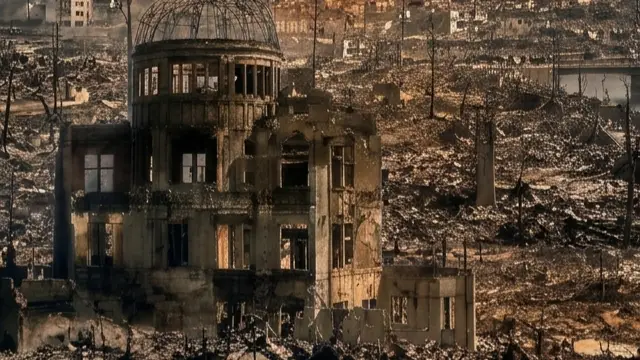
What happened at 8.15am on August 6th 1945
Within seconds, a powerful flash of light, extreme heat and a massive blast destroyed large parts of Hiroshima. Buildings collapsed, fires spread and thousands of people lost their lives. Many others suffered terrible burns and injuries.
The suffering did not end that morning. Survivors continued to face serious health problems caused by radiation, and many died in the months and years that followed.
According to Hiroshima City estimates, around 140,000 people had died by the end of December 1945. The exact number is uncertain, but behind this figure were thousands of ordinary people, including children, parents, students, workers, and the elderly.
Think of someone who left home that morning expecting to return that evening. A child walking to school. A mother preparing breakfast for her family. Each had their own dreams and plans for the future.
But everything changed in seconds.
For the people of Hiroshima, their city was not a military target on a map. It was their home. Political and military leaders make decisions, but ordinary people often pay the highest price.
Why was the atomic bomb used?
To understand the bombing, we must look at the situation during the Second World War.
Japan had attacked Pearl Harbor in 1941, bringing the United States directly into the war. Fighting between Japan and the Allied forces continued across the Pacific, causing enormous loss of life.
By 1945, the war had already taken a terrible toll. American leaders believed that invading mainland Japan could result in even greater casualties. They argued that using the atomic bomb would force Japan to surrender and bring the war to an end sooner.
However, historians still disagree about whether the bombings were necessary.
Could Japan have been made to surrender through diplomatic negotiations? Could the United States have demonstrated the power of the bomb before using it on a populated city? Would changing the surrender conditions have made a difference?
Another important question is how much the Soviet Union’s entry into the war against Japan influenced Japan’s decision to surrender.
Different views on these questions persist, and historians continue to study them. We should understand the circumstances of that time, but never forget the enormous human suffering caused by the bombings. Explaining why a decision was made does not automatically mean that the decision was morally right.
Historical facts also matter. President Harry S Truman played a central role in the decision to use the atomic bomb. Records show that he effectively approved the bombing before it happened, although the exact nature of his written authorisation remains a subject of historical discussion.
Nagasaki, another city and another tragedy
Just three days after Hiroshima, on August 9th 1945, another atomic bomb, called Fat Man, was dropped on Nagasaki.
Once again, an entire city faced destruction. Thousands of people were killed, buildings were destroyed and many survivors suffered serious injuries and radiation-related illnesses.
Japan announced its surrender on August 15th 1945. The formal surrender was signed on September 2nd, ending the Second World War.
The bombings of Hiroshima and Nagasaki introduced the world to the nuclear age, a period in which humanity possessed weapons capable of destroying entire cities within seconds.
The survivors of the atomic bombings are known as hibakusha. Many lived with long-term health problems, emotional trauma and social discrimination. Their experiences demonstrate that the consequences of nuclear weapons extend far beyond the moment of detonation.
Are nuclear weapons really protecting us?
After the Second World War, many powerful countries began developing and stockpiling nuclear weapons, triggering a dangerous nuclear arms race.
The main argument used to justify maintaining these weapons is called nuclear deterrence. Supporters believe that the fear of retaliation prevents countries from attacking one another and helps avoid major wars.
But this strategy depends on the assumption that miscalculations, technical failures and human errors can always be avoided.
What happens if a country misunderstands another country’s actions? What if a technical failure or human mistake leads to a nuclear attack? What if a conflict between two countries escalates into nuclear war?
These are not imaginary dangers. They are serious risks that the world continues to face.
The Stockholm International Peace Research Institute (SIPRI) estimated in its 2026 yearbook that the world had around 12,187 nuclear warheads in January 2026. Nine countries possessed nuclear weapons, and all continued to maintain or modernise their nuclear arsenals.
Imagine the destructive power these weapons represent.
Countries maintain nuclear arsenals in the name of protecting their people. But if these weapons were ever used on a large scale, millions of ordinary people could lose their lives. The consequences could cross national borders and affect future generations.
Another worrying development is the New START treaty’s expiry between the United States and Russia on February 5th 2026, without a replacement agreement. The treaty placed limits on the two countries’ strategic nuclear weapons.
Its expiry has weakened an important nuclear arms-control system. As international tensions rise, the need for dialogue, cooperation, and arms-control agreements has grown even greater.
The danger of nuclear escalation in today’s conflicts
The world today is witnessing several ongoing conflicts and rising geopolitical tensions, including the Russia-Ukraine war, tensions involving Iran and the United States, the Israel-Houthi conflict and other regional confrontations.
If nuclear weapons were ever used in any of these conflicts, the consequences could be devastating, not only for the countries directly involved but for humanity as a whole. Beyond the immediate loss of millions of lives, nuclear warfare could cause widespread radiation exposure, long-term environmental contamination, destruction of infrastructure, disruption of global food production and severe climatic consequences.
Even a limited nuclear exchange could have effects extending far beyond the battlefield. Smoke and soot from large-scale fires could enter the atmosphere, potentially affecting temperatures, agriculture and food security across distant regions. A regional conflict could therefore become a global humanitarian catastrophe, threatening the lives and livelihoods of people who had no involvement in the war.
The lesson of Hiroshima and Nagasaki is not confined to 1945. It warns the world today. In an era of growing military tensions and nuclear arsenals, preventing nuclear escalation must remain one of humanity’s highest priorities.
Science is a gift and a responsibility
Nuclear science has given humanity many useful things. It is used in electricity generation, cancer treatment, medical research, agriculture and several other fields.
But the same scientific knowledge has also been used to develop weapons capable of destroying millions of lives.
Science itself is neither good nor bad. What matters is how human beings use it. The responsibility lies with governments, institutions and leaders who decide how scientific discoveries should be applied.
The real question is whether a world that depends on the threat of mass destruction can ever be truly safe.
A weapon may appear useful from a military point of view, but that does not make its consequences acceptable to humanity.
Remembering Hiroshima and Nagasaki should not mean blaming ordinary people living in countries today for decisions made by their governments in the past. Nor should the suffering of civilians in any present-day conflict be ignored. Human lives should never be sacrificed in the name of national power or political interests.
We must never see another 8.15
The United Nations observes September 26th as the International Day for the Total Elimination of Nuclear Weapons. It reminds the world that nuclear disarmament is not merely an ideal but a responsibility shared by all nations.
Nuclear-armed countries have a special responsibility to reduce their arsenals and rebuild trust. Other countries, international organisations and ordinary citizens must also support efforts towards a safer world. Achieving this goal requires international cooperation and a shared commitment to peace.
August 6th 1945, at 8.15am, was not just another date in military history. It was a day when humanity witnessed the terrible power of its own scientific discoveries.
An atomic bomb destroyed a city, thousands of families lost their loved ones, and generations of survivors carried the pain.
More than eight decades later, the message remains clear.
We have developed the power to destroy ourselves. Now we must develop the wisdom to prevent it.
The greatest tribute we can pay to the victims of Hiroshima and Nagasaki is not simply to remember them or repeat the words “Never again”. It is to work towards a world where nuclear weapons are no longer a threat to human life, and where future generations can live without the fear of another Hiroshima or Nagasaki.

A veterinary professional, science writer, and nature enthusiast from Andhra Pradesh, India. His writing explores science, astronomy, biodiversity, and humanity's relationship with the natural world.