
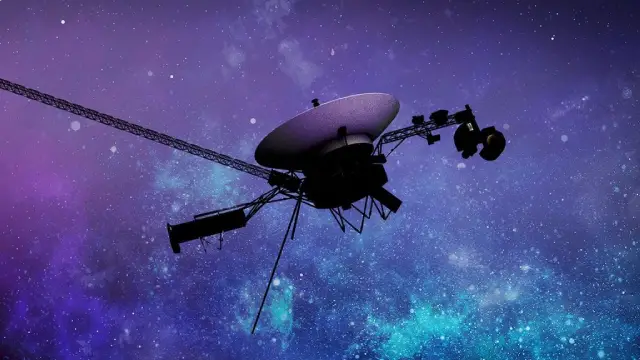
Voyager 1 reaches one light-day from Earth after 49 years
Voyager 1 is now one light-day from Earth, a distance that shows how unimaginably large the universe is. Launched by NASA on September 5th 1977, the spacecraft has been travelling through space at roughly 61,000 km per hour. Nearly 49 years later, it has reached about one light-day from Earth. NASA’s trajectory calculations placed the spacecraft at this remarkable milestone on November 18th 2026.
Think about that for a moment.
What one light-day from Earth means for Voyager 1
It took a spacecraft travelling at around 61,000 km/h almost 49 years to cover a distance that light itself travels in just 24 hours. One light-day is approximately 25.9bn km. At Voyager 1’s approximate speed, covering that distance takes close to 49 years.
Now imagine how long it would take to travel one light-year at the same speed. A light-year is the distance light travels in one year, approximately 9.46 trillion km. At 61,000 km/h, Voyager would take roughly 17,700 years to cover it.
How far is the nearest star at Voyager’s speed?
The nearest star to our Sun, Proxima Centauri, is about 4.24 light-years away. At the same constant speed, a journey across that distance would take approximately 75,000 years. That is not a practical travel forecast. It is a simple comparison to help us grasp the scale involved.
And remember, we are talking about one of humanity’s farthest-travelling spacecraft. Voyager 1 has travelled farther than any other human-made object, yet even this extraordinary journey has taken it only about one light-day from Earth.
The observable universe at Voyager’s pace
Now think about the observable universe, which is roughly 93bn light-years across. Using the same simple comparison and imagining travelling that distance at Voyager 1’s speed, the journey would take around 1.6 quadrillion years. This is only a thought experiment. The observable universe is expanding, so its present-day size isn’t a fixed distance a spacecraft could simply cross at a constant speed. NASA explains how big space is and why expansion matters.
Sometimes, when we look up at the night sky, we see thousands of stars and feel that the universe is within our reach. But when we put these distances and numbers into perspective, they become almost impossible to comprehend.
The universe is fascinating, humbling and, at the same time, a little scary. It makes you realise just how small our little world is in the grand scheme of things.
The travel-time figures are approximate calculations based on a constant speed of 61,000 km/h. Actual spacecraft trajectories and distances are more complex.

I am an independent astronomy enthusiast and science admirer based in Lucknow, India. Although I am not a professional scientist, I have a keen interest in astronomy and enjoy communicating scientific ideas to a wider audience.