
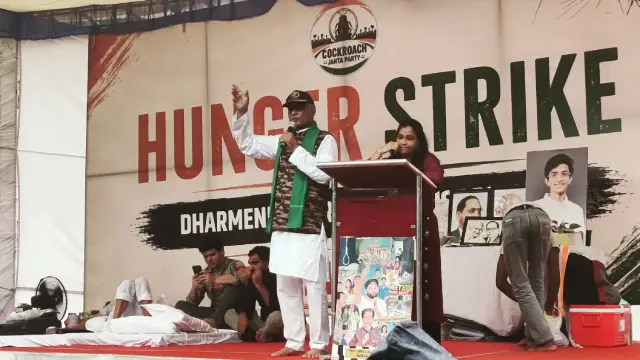
Gen Z protest at Jantar Mantar: youths break neoliberal silence
The Gen Z protest at Jantar Mantar during the monsoons has made India’s political parties sit up and listen to a generation they long treated as an afterthought. From Leader of the Opposition in the Lok Sabha Rahul Gandhi to Rashtriya Swayamsevak Sangh (RSS) chief Mohan Bhagwat, political leaders have started praising Gen Z, addressing its concerns, and even speaking to it in “Gen Z language” through speeches and parliamentary debates. What has changed? Did politicians notice Gen Z first, or did Gen Z become politically aware and make its interests visible?
Parties are shifting their focus sharply toward Gen Z, knowing this generation will make up the single largest bloc of voters by 2029, according to the 2011 Census data. Targeted digital campaigns, AI videos, meme-literate social media handles and campus interactions are replacing traditional rallies. Gen Z participants say they don’t want to be treated as passive recipients of patronage or election-time optics; they want to be treated as economic and social partners. Political strategists note that winning over this generation takes open governance and structural delivery rather than symbolic gestures or superficial social media campaigns.
Why Gen Z political participation felt out of reach
Under neoliberalism, young people are overwhelmed by hyper-competitive education, internships, examinations, unemployment and uncertain career prospects. In this environment, Gen Z political participation can feel like an unaffordable luxury. Voting, joining organisations, attending meetings, taking part in student politics or engaging with parliamentary processes all require time and a belief that participation will produce change. The dominant neoliberal discourse frames non-participation as an individual choice rather than social exclusion.
To a large extent, this has long disconnected a particular section of society, and those in power, from ordinary people. That is one practical failure of representative democracy. Young people are also tired of unfulfilled promises and propaganda.
Turning point: satire, rage and a Gen Z protest
What caused this dynamic to shift? Systemic problems affecting young people – exam paper leaks, inadequate school facilities, unemployment, student suicides and underqualified teachers – are not new. Political parties opened their eyes because Gen Z applied public pressure by gathering at New Delhi’s Jantar Mantar.
Would the movement have had the same influence if Abhijeet Dipke had not used satire in his first post on X? Would the Instagram handle of the Cockroach Janata Party (CJP) have gained millions of followers after its launch if it had not parodied the Bharatiya Janata Party (BJP)?
Dipke used rage as satire. Satire mobilised the public’s anger, contempt, disgust and disdain and gave them a voice. Digital media has opened political participation for Gen Z beyond traditional activism, and viral humour, meme culture and satirical commentary have become new ways to take part. In this movement, satire began as humour, but anger and frustration lay beneath it and gradually became evident to the audience.
Unlike other forms of online political engagement, this movement extended beyond the digital sphere and translated into offline mobilisation that could influence institutional responses. The size of the mobilisation and the crowds it drew showed that people already felt deep rage, dissent, and disappointment with the system. What had been lacking was a platform for Gen Z to raise these issues collectively. The emergence of the CJP as an apolitical platform with no electoral motive provided exactly that, and the two went hand in hand. Digital media helped by providing networking and connectivity, turning public rage into a collective organisation that demands accountability from the system.
Millennials led and organised the movement, strategically translating structural grievances for a digital generation. This alignment democratised political participation, shifting Gen Z from passive online spectators to active stakeholders in institutional governance.
Pedagogies of dissent: the Gen Z protest at Jantar Mantar
The author attended the protests at Jantar Mantar from beginning to end as a student observer and saw political education unfold not just on the main stage but among the crowds gathered before it. Spontaneous, decentralised spaces emerged across the site as student organisers erected makeshift tents, beat their daflis (hand drums) in rhythm and sang songs of resistance.
“Jai Bhim! Jai Bhim! Manuwaad ki chhati par – Birsa, Phule, Ambedkar! Brahmanwaad ki chhati par – Birsa, Phule, Ambedkar!” (Hail Bhim! Hail Bhim — on the chest of casteism, Birsa, Phule, Ambedkar! On the chest of Brahminical hegemony, Birsa, Phule, Ambedkar!)
Slogans such as “Jai Bhim” echoed across Jantar Mantar not merely as a reference to Ambedkarite thought, but as a universal language of courage against systemic oppression.
Another slogan went: “Rohith Vemula tere sapno ko, hum manzil tak pahunchenge!” (“we will carry your dreams to their destination”). For Gen Z students who entered the space concerned initially with examination paper leaks, the surroundings connected an immediate grievance to broader institutional collapse and kept alive the memory of incidents such as that of Rohith Vemula. Witnessing this unity across caste, religious and gender identities showed how the physical protest space could undo the hyper-individualistic, neoliberal conditioning of the mind, and taught a genuine sense of intersectional democratic unity.
Gen Z protest as a lesson in pluralism
What made the space transformative was its raw, visible, practical pluralism, in leadership, organisation and solidarity alike. Sonam Wangchuk is the indigenous, tribal voice of Ladakh; Dipke is a Dalit; and the crowd itself reflected an inclusive coalition of caste, religious and LGBTQ+ identities. On the ground, the unity that exists as theory in books was realised as possibility. A Hindu man in traditional bhagwa (saffron) stood shoulder to shoulder with a Muslim man, and participants from completely different faiths served food together to fellow protesters.
For a Gen Z often conditioned by algorithms into hyper-individualism, witnessing this solidarity between communities in real time proved that the constitutional ideal of “unity in diversity” is not merely an abstract concept confined to textbooks. It can be, and was, dismantled, reconstructed and practised on the street.
If Indian democracy is to remain healthy and truly representative, it will happen through spaces and platforms that allow young citizens to organise beyond partisan lines. In these physical areas of collective action, Gen Z, a generation that was invisible and isolated, is discovering something far more potent: unity, purpose and the power to demand real accountability.

A fifth-year student of law from New Delhi.