
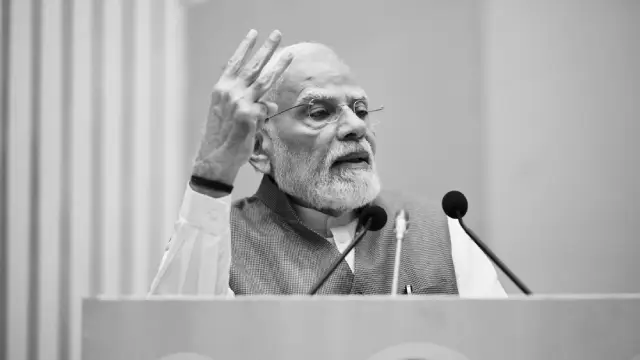
Modi’s Vishwaguru illusion runs dry in 2026
Political communities, like individuals, can sustain a flattering illusion for a surprisingly long time but never indefinitely, because reality keeps its appointments with a punctuality that propaganda cannot postpone. For more than a decade, India’s governing establishment has invited its citizens to inhabit a carefully illuminated stage on which the country figured as a Vishwaguru (global leader), as the fourth-largest economy on earth, and as a power whose every diplomatic gesture, in the vocabulary of its own television studios, set the world’s drums beating. In May 2026 that stage, and with it Prime Minister Narendra Modi‘s Vishwaguru illusion, collapsed. What ended the performance was Modi’s own voice, which urged a population promised civilisational ascent to consume less fuel, suspend gold purchases and abandon foreign travel.
Modi’s Vishwaguru illusion meets the petrol pump
The vulnerability was structural, the cumulative product of a decade in which energy security was proclaimed in slogans rather than secured in policy, and it was aggravated by a foreign policy that had abandoned the strategic autonomy India once professed. Modi’s visit to Israel, days before the American-Israeli assault on Iran, was more than a diplomatic misjudgment. Despite India advocating for dialogue, this move has cost New Delhi the neutrality that once let it trade with every camp, and the bill for that loss arrived at the petrol pump.
Spectacle in place of delivery
To understand why such structural neglect was possible, one must examine what the state was doing instead, and here the logic of Hindutva statecraft becomes indispensable. A political project that rests on majoritarian identity rather than material delivery must perpetually generate occasions for collective emotion, which is why temple inaugurations, ceremonial sceptres, mass pilgrimages and televised festivals absorbed the attention and treasure that governance would otherwise have demanded. Political capital was likewise expended on engineering defections, prosecuting critics and activists and tolerating vigilante violence, while Modi’s ruling Bharatiya Janata Party (BJP) financed itself through an electoral bond scheme that India’s own Supreme Court eventually struck down as unconstitutional. None of this fits the self-portrait of a so-called disciplined state devoted to national reconstruction, and one instrument made it all tolerable to the public: the media.
‘Godi media’ and a war that existed only in studios
That instrument is the broadcast apparatus colloquially known in India as the ‘Godi media’ (lapdog media), whose conduct during the May 2025 India-Pakistan border confrontation exhibited what happens when the press peddles propaganda. On the night of May 8th, Indian anchors screamed their way through a war that existed only in their studios, “capturing” Karachi and Islamabad without a single verified fact between them. It took India’s own independent fact-checkers to point out that none of it had happened. Almost no major channel keeps its own fact-checking desk, which is hardly surprising, since an outlet that sells jingoism by the hour has no use for the truth. Pakistani broadcasters, by contrast, took the trouble to dissect these fabrications on air.
The generation that stopped believing
A scapegoat retains its utility only while the audience believes in it, and cultivated credulity has limits. A generation beyond the reach of the Godi media has now demonstrated them. The Cockroach Janta Party (CJP) began in May 2026 as an online satire launched by the communications strategist Abhijeet Dipke. Driven by anger over leaked national medical entrance examination and rising youth unemployment, it grew into one of the largest youth movements in recent years. These were precisely the domestic failures the manufactured external enemy was meant to obscure, and the state responded with tear gas, mass detentions and policing that appeared intended to inflict harm rather than disperse crowds.
The strategy failed. After seven weeks of sustained pressure, the then education minister, Dharmendra Pradhan, resigned on July 25th, and protesters resisted the media blackout and smear campaigns of the same channels that had invented the conquest of Karachi, building their own public sphere on Instagram. The pattern has since intensified. Online activists aligned with the ruling BJP have sought to expose protesters’ personal details, and thousands were detained in October over a contested revision of the voter list. A government that treats its young citizens as threats to be suppressed rather than constituents to be heard has forfeited any credible claim to moral leadership.
What remains of Modi’s Vishwaguru illusion
The conclusion that follows is unavoidable. Hinduism, as a living faith, never promised to refill an empty fuel tank or to create employment for a restless generation; the far-right political movement called Hindutva made precisely such promises by substituting symbolism for substance and enmity for policy. Legitimacy built on spectacle must be renewed through ever larger spectacles, and this year’s events show where that logic ends. It ends in a manufactured enemy that no longer persuades, a media apparatus that no longer commands belief and a generation that has turned from the scapegoat to the government itself.
India’s rulers now stand before the appointed hour of reality, having exhausted their stock of scapegoats. India must choose whether to keep manufacturing an enemy across its western frontier or answer the demands of its own people, and this year’s evidence suggests the people have already made their choice.

Misbah Ashiq Ali is an independent researcher based in Islamabad, Pakistan, focused on climate change, security, militancy, and South Asian affairs. She can be reached at [email protected]